

What is partner journey management?
The partner journey is the full lifecycle of a partner's relationship with you, from first awareness through onboarding, enablement, first deal, and ongoing growth. Partner journey management means deliberately designing and running those stages, with a clear goal, a measure of progress, and someone responsible for the next step.
Like the customer journey, it helps you understand what someone needs before they commit and as the relationship develops. But a partner keeps choosing whether to sell your solutions or a competitor's. While the customer journey can also include retention, the partner journey adds a repeated decision to invest in selling or delivering another vendor's product.
Three terms describe different parts of that work:
- Partner journey: The path your partners experience.
- Partner journey management: How you run and improve that path.
- Partner lifecycle management: How you define, monitor, and move partners through the underlying stages.
The partner journey is also part of partner ecosystem management, connecting individual relationships to your wider channel strategy. Mapping it reduces confusion and helps both organizations align their partner programs around shared expectations.
The test is practical. Each step should move a selling partner toward a registered, closed, repeatable deal. Naming the steps alone won't produce that outcome.
The two tracks of the partner journey
A partner journey has two views. One follows the partner's decisions. The other follows the processes you operate. You need both to understand whether the relationship is progressing.
The map stays dynamic because partners can reconsider during onboarding or need fresh enablement when entering a new market.
- The outside-in view starts before partners join. They explore your offer, compare incentives, and discover what other partners say about your support. Your recruitment content and reputation shape whether partners apply.
- The inside-out view gives the partner journey structure. Your team assigns owners, provides resources, and checks milestones. Yet completing those tasks doesn't prove the partner still wants to move forward.
You might be sending training while partners no longer see a market opportunity. That mismatch is where silence begins. At each handoff, confirm that partners' next actions still serve both sides' business goals. Mutual value is essential to partnership success.
The partner journey stages, goals, KPIs, and failure modes
Use this operating model to connect activity to outcomes. Each row gives you a goal, a primary KPI, and a failure mode. Supporting measures help explain the result, but one headline measure keeps ownership clear.
Stage 1: Recruit partners with a clear path to their first deal
Goal: Prioritize fit over volume through partner recruitment, checking market reach, relevant customers, and the capacity to support them.
KPI: Review eventual activation by recruitment cohort to test whether your selection practices bring in productive partners.
Failure mode: Organizations join for the badge or incentives without a credible route to their first opportunity.
Stage 2: Onboard partners so they're ready to act
Goal: Get new partners ready to act, with essential access, clear ownership, and agreed-upon expectations. A focused partner onboarding guide helps define what “ready” requires for each type.
KPI: Measure time to onboarding complete. Removing avoidable delays can shorten time-to-revenue, but completion is only a readiness signal.
Failure mode: Partners finish every module without knowing whom to approach or how to submit an opportunity. Onboarding completion is not activation.
Stage 3: Enable partners to sell your product confidently
Goal: Make your offer easy to sell alongside competing priorities. Sales training, marketing materials, and practical resources should help partners match solutions to customers' business needs. Effective enablement gives partners continuous support as products and market conditions change.
KPI: Measure relevant asset usage, with certification as a supporting check where technical skills matter. Guided selling for partners connects that knowledge to product, pricing, and quoting decisions.
Failure mode: You publish more resources while partners keep asking the same questions. Asset volume says little about whether partners use the material effectively.
Stage 4: Activate partners through their first registered deal
Goal: Secure the first qualified, registered deal. Treat this as a distinct milestone in the partner journey, because a vague “engage” label can hide the critical gap between learning and acting.
KPI: Calculate activation rate as the share of an eligible partner cohort registering a first qualified deal within a defined period. Pair it with time to first deal registration, measured from the same starting point, such as enrollment. Keep the first registration separate from the first closed-won deal.
Failure mode: Partners complete training but never identify a prospect or abandon a cumbersome submission process. Partner activation addresses that transition.
A simple deal and lead registration process makes that first step easier.
This is the hinge of the partner journey. More recruitment won't help if partners can't make the first commercial move.
Stage 5: Co-sell with partners to win live opportunities
Goal: Help partners win live deals with clear sales responsibilities and timely support. Carry guided selling for partners into the opportunity so enablement informs the next decision.
KPI: Use win rate, supported by partner-sourced and influenced pipeline. Report sourced and influenced contributions separately, and count each opportunity once in combined pipeline totals.
Failure mode: Partners and direct sales work from separate email threads and spreadsheets. Sales forecasts and partners' credit become unreliable.
Stage 6: Grow and retain partners through repeat business
Goal: Make the first win repeatable. Regular business reviews should align business goals, check whether incentives still motivate partners, and identify where additional service or technical support would help.
KPI: Monitor active-partner retention alongside repeat pipeline. Define “active” through partners' commercial activity within a suitable period.
Failure mode: A first win creates false confidence while ongoing engagement fades. Use reviews to optimize partner performance, then feed lessons back into the partner journey. Long-term growth depends on earning partners' next commitment.
A successful partner journey keeps partners moving from one win to the next.
Why partner programs lose partners between stages
The most dangerous part of the partner journey can be the silence between milestones. Activity creates records. An action that never happens leaves nothing to count unless you deliberately monitor its absence.
Without a time-based check, no alert fires when a partner stops registering deals. You may finally discover the drop-off at the next quarterly review, roughly ninety days after momentum faded.
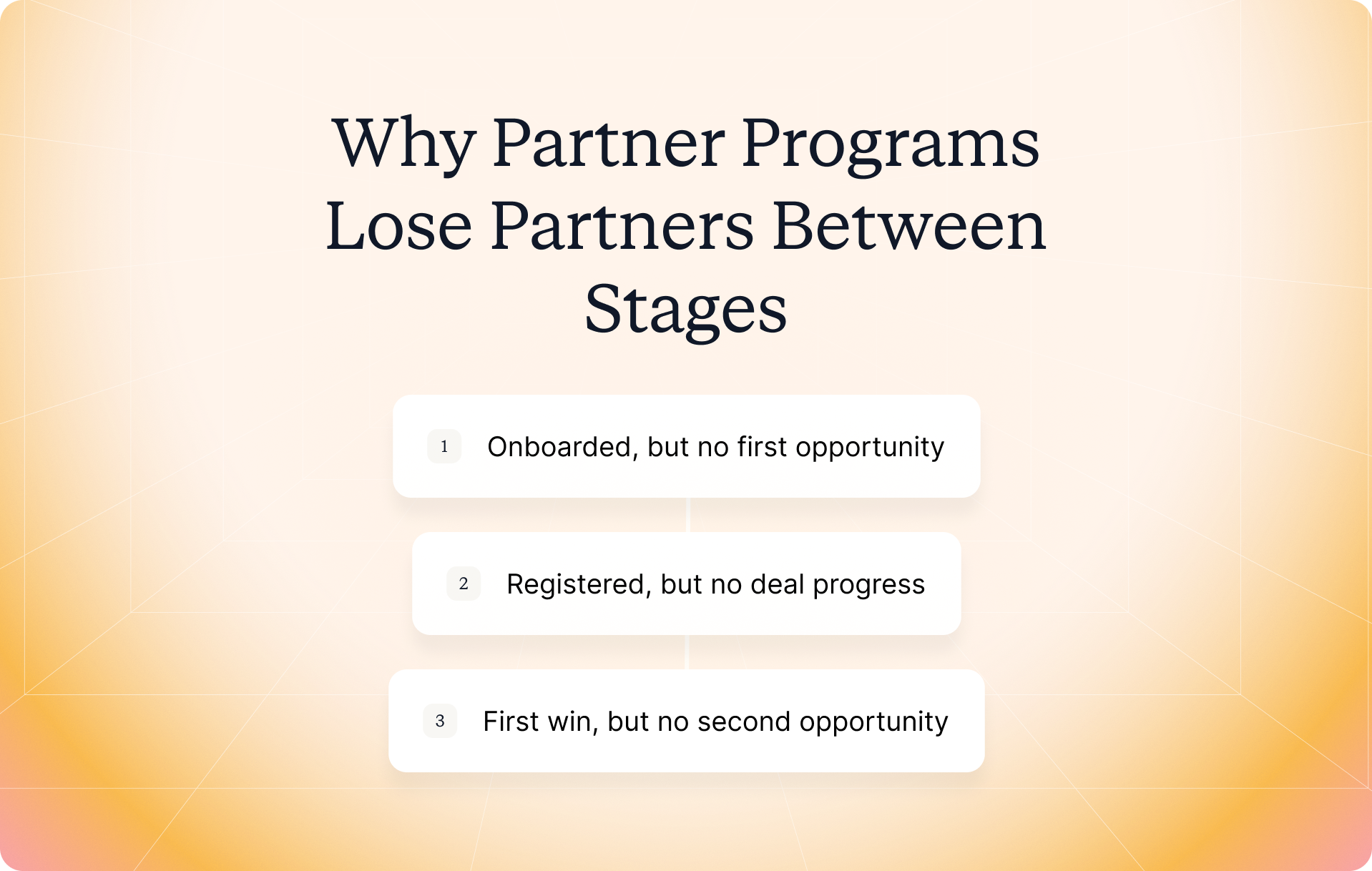
Define what “active” means throughout the partner journey, from partner activation to repeat deals, then look for missed transitions:
- Onboarded, but no first opportunity: Check whether partners have realistic prospects and enough support to act.
- Registered, but no deal progress: Check owners, response times, and partners' unresolved questions.
- First win, but no second opportunity: Check whether partners still have a reason to invest.
Set time windows by partner type and buying cycle. Partners referring occasional clients need a different cadence from regular resellers.
Performance monitoring is crucial throughout the partner journey, but look beyond portal logins. Partners may engage through email instead.
Use partner communications to ask what's blocking progress. Those answers offer valuable insights to optimize handoffs, support retention, and keep partners engaged.
How the channel partner journey changes by partner type
A channel partner journey should reflect how partners earn money and serve customers. Referral partners and resellers share broad lifecycle labels, but a generic checklist adds unnecessary work.
Tailor the work by partner type while keeping shared definitions for ownership, progress, and contribution. Developing channel partner paths on one model keeps partner programs connected. Focus on partners' working needs to make collaboration easier.
Why partner relationship management belongs on your CRM records
When milestones sit in a portal and opportunities sit in the CRM, separate tools show training and closed deals without connecting partners' progress.
Connect partner milestones to deal outcomes
The practical PRM vs. CRM question is how partner relationship management connects to records your business already uses. Link partners' status, milestone dates, and ownership to deals.
Clear partner attribution identifies who sourced or influenced each opportunity. Missing or stale relationships weaken reporting and can cause registration checks to miss competing claims.
Track progress and overdue transitions
Create a minimum data set to track the partner journey:
- Current partner status and milestone dates
- Last meaningful action
- Next owner
- Linked opportunities
Keep these fields current so real-time dashboards provide visibility into progress and overdue transitions, helping you optimize processes based on outcomes.
Let partners work outside the portal
With headless partnerships, partners act through email, Slack, or connected CRM tools. Writeback updates the shared record without a portal login, while a portal can still offer self-service access to resources.
What to automate in the partner journey
Partner journey automation should remove waiting and surface the right next step. Start with repeatable program processes where partners' next actions are clear. Assess automation tools and platform capabilities against those needs, including how they connect to your existing solutions.
- Onboarding: Send access instructions and notify the owner when a required task is overdue.
- Training: Assign relevant learning and reminders when a role or product changes.
- Activation: Flag completed onboarding without a first registration after the agreed window.
- Retention: Prompt a renewal conversation or check-in when repeat activity slows.
These automated workflows can reduce onboarding friction and help partners become productive sooner. Notifications guide milestones, while training prompts support engagement. Faster time-to-first-deal depends on removing real obstacles.
Use partner communications practices to keep automated communication relevant. Two simple tips: stop reminders after completion and route replies to someone who can help.
Human judgment remains crucial. Months of automated emails alone can lose partners' interest. Keep conversations about trust, strategy, and the relationship personal.
How Introw connects the partner journey to your CRM
Introw's CRM-first, AI-native partner management platform helps you manage partners around existing records. The platform connects partners' progress and contribution through familiar tools.

The HubSpot integration keeps HubSpot as the CRM system of record with two-way synchronization.
For teams using Salesforce, the Salesforce integration brings partner collaboration and updates onto existing records. Your program retains the system that already holds opportunities.
AI can assist with checks on complex deals involving several partners. Your policies govern decisions, so your channel team can focus on fair outcomes while these technologies handle routine checks.
You don't need every partner to complete every step. You need a partner journey you can run effectively, with consistent practices and evidence of partners' success and growth.
If your portal says partners are progressing but your pipeline tells another story, book a demo to see how Introw connects partner milestones, deal activity, and attribution in your CRM.
Still curious? Here are some quick answers to help clear things up
The partner journey is the path your partner experiences, from first contact to ongoing collaboration. The partner lifecycle defines the stages along that path, while lifecycle management is how you operate them through clear owners, actions, and measures.
Give each stage a KPI, such as onboarding time, activation rate, deal win rate, or repeat pipeline. Also watch for transitions that don't happen, including completed onboarding without a first deal or a first win without another opportunity.
The customer journey centers on buying and using your product, though it can continue through retention and advocacy. The partner journey loops through selling or delivering your product repeatedly, with partners deciding each cycle whether working with you still deserves their time and effort.



Are you already an active Introw partner?
Book a demo with one of our partner program experts, or explore Introw on your own time.