

What is a strategic alliance?
A strategic alliance is a formal agreement between two or more independent companies to work together toward shared goals, pooling resources or capabilities, while each remains a separate legal entity and separate business entity.
That's the core of the strategic alliance definition, though the strategic alliance meaning is often used interchangeably with strategic partnerships or business alliances.
Three things define it.
- The companies stay independent. No shared ownership, no merger, no combined entity, and no new business entities need to be formed.
- The collaboration is formalized. This isn't an informal favor between two account managers who like each other. There's an agreement, a scope, and a named owner on each side.
- Both sides expect mutual benefit. Each company brings something the other doesn't have, and both expect mutual benefits worth the coordination.
Companies typically form a strategic alliance to gain access to new markets, share resources they'd otherwise duplicate, or pick up new technology and intellectual property. Others are after distribution reach, brand credibility, competitive advantage, or a specialist capability they haven't built in-house.
Forming a strategic alliance for the wrong reason (chasing a logo rather than a real gap) is one of the most common early mistakes.
Strategic alliance is the umbrella strategy term. Partnership is the general relationship. And co-selling is the operational motion most strategic alliances actually run on once they're signed.
In Introw's framework, the alliance partner on the other side of one of these deals is handled as a co-sell partner type. It's a full partner organization that mirrors your own sales team, with an alliance manager, reps, and a solutions engineer selling side by side on shared accounts.
The strategy term describes the agreement. The co-sell motion is what the agreement looks like day to day.
The main types of strategic alliance
Two or more companies can structure strategic partnerships several ways. The right structure depends on how much risk, capital, and control the companies involved want to put in.
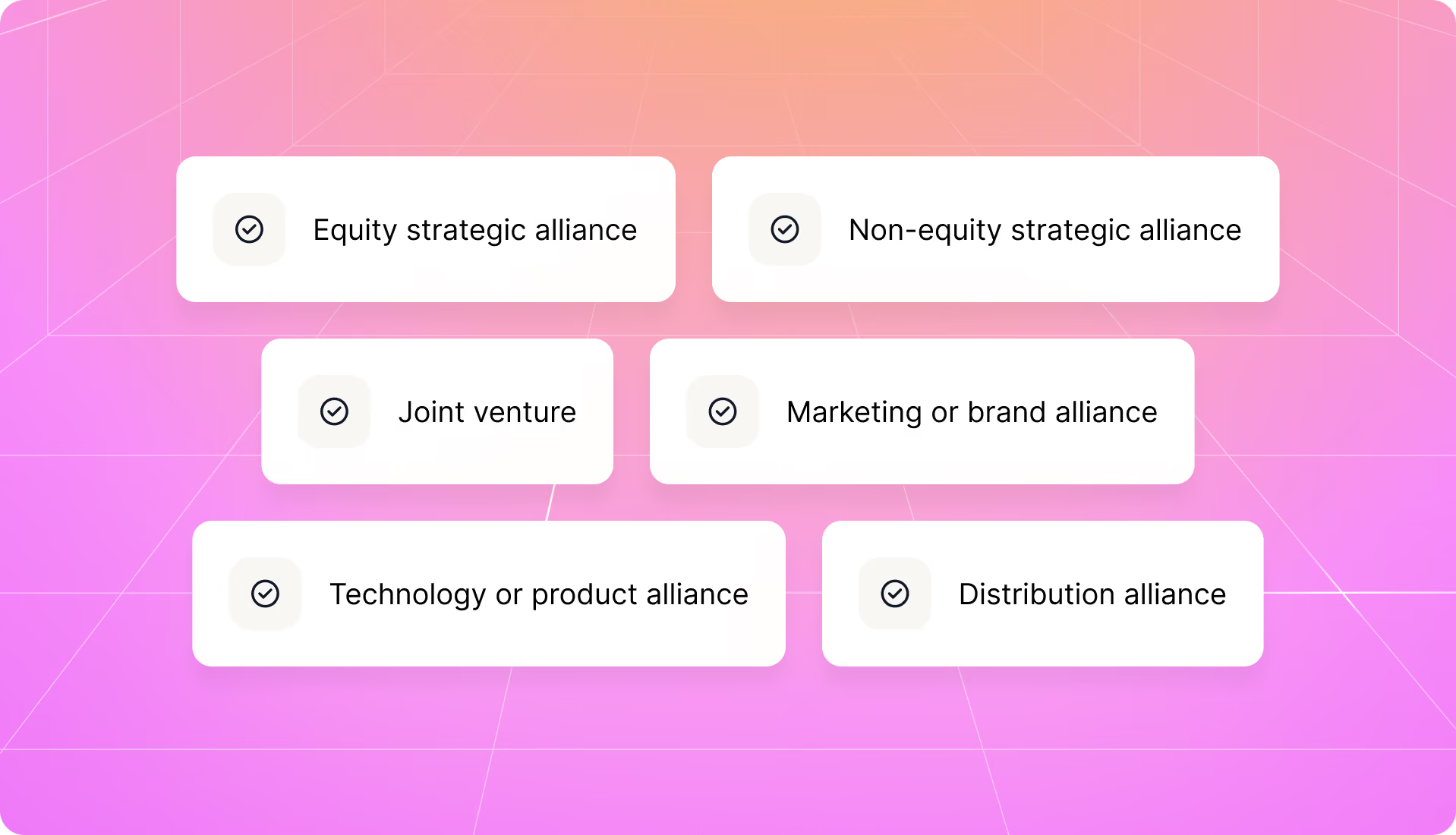
Here are the main types of strategic alliances, or types of strategic partnerships, depending on which term you use.
Non-equity strategic alliance
A non-equity strategic alliance is a contractual agreement between two or more companies to collaborate, with no ownership changing hands. This is the most common structure by far, especially between two SaaS vendors agreeing to co-sell and integrate, and it's often one of the more successful business strategies precisely because it's low-risk.
Equity strategic alliance
One company purchases a minority stake in the other to deepen commitment, often to fund a push into new markets. A large platform investing in a strategic ISV is a typical example of an equity strategic alliance.
Joint venture
The two parent companies form a new, jointly owned entity, sometimes called a child company, that sits apart from both of them and lets both share resources to enter new markets neither could reach alone.
Marketing or brand alliance
Joint campaigns, co-branding, and shared audiences, without any product integration. Co-hosted events and co-branded content are the usual output.
Technology or product alliance
Two companies integrate their products so the combined solution is worth more than either alone, usually paired with a joint go-to-market motion.
Distribution alliance
One partner sells or distributes the other's product into a market it already has a presence in, letting both companies share resources like shelf space and an existing sales force. Reaching new markets through an established player is far faster than building a local sales team from scratch.
Vertical vs. horizontal alliances
Most of the alliances above are horizontal, formed between companies in the same industry. A smaller category, vertical strategic alliances, connects companies at different points in the same supply chain, say a manufacturer and a distributor.
Neither side in a vertical deal is positioned to compete with the other directly, which is why these different types of strategic alliances carry a different risk profile.
It's also worth separating any of this from a technology partner program, which is built for a large volume of lighter-touch integration partners, not the small number of deep, executive-level alliances covered here.
The takeaway
Most B2B SaaS alliances are non-equity technology or distribution alliances, since a non-equity strategic alliance requires no capital and no new business entity.
That's precisely why they're the fastest to form and the easiest to fold into a broader business strategy, and also why they're the easiest to neglect once the joint motion isn't backed by anything structural.
Strategic alliance vs. joint venture (and other partnership models)
Strategic alliance versus joint venture, or joint venture versus strategic alliance, the comparison comes down to the same table.
The dividing line comes down to one question: does a new company get created? In a strategic alliance, both partners stay whole, resulting in two companies, two boards, and two P&Ls.
In a joint venture, the parent companies co-own a new entity, often still called a child company, that has its own leadership and its own books.
That difference drives everything else. A joint venture involves shared capital and shared governance between the two parent companies and a much harder exit if things go wrong. A strategic alliance is faster to form and far easier to unwind, which is why strategic alliances are more common than joint ventures between independent organizations and also why they're easier to neglect.
Strategic alliance examples
Named alliances change and quietly dissolve. These examples of strategic alliances are checked against current, active partnerships rather than pulled from an older list.
Technology and product alliance: Salesforce and AWS
- The deal. In late 2025 and early 2026, the two companies launched Agentforce 360 for AWS, running on AWS infrastructure with formal co-selling incentives and a marketplace listing.
- Salesforce gets a scalable infrastructure layer for its AI products.
- AWS gets deeper distribution into Salesforce's enterprise base.
Equity alliance: Microsoft and OpenAI
- The deal. Microsoft built a minority stake in OpenAI over several funding rounds, as OpenAI's models became central to Copilot and Azure AI.
- What changed. A 2026 restructuring altered some exclusivity terms, a reminder that even a well-funded equity strategic alliance gets renegotiated as the market shifts.
Distribution alliance: Starbucks and Target
- The deal. Starbucks licenses its brand to Target, which places Starbucks cafes inside its stores and hires the baristas itself, a relationship the two companies have run since 1999.
- Starbucks gets foot traffic and brand exposure it doesn't have to build.
- Target gets a high-margin amenity that keeps shoppers in the store longer.
Marketing alliance: Disney and General Motors
- The deal. The two companies have collaborated on EPCOT's Test Track attraction for more than four decades, dating back to the original World of Motion exhibit in 1982. GM sponsored the ride as Chevrolet from 2012 to 2024, returning to the General Motors parent brand in 2025.
- GM gets sustained brand exposure to millions of visitors a year.
- Disney gets a marquee sponsor whose theme fits the ride.
These strategic alliance examples share a pattern. Both sides had something the other genuinely couldn't build or buy quickly, both saw mutual benefits and real competitive advantage from the combination, and both had an ongoing commercial reason to keep showing up. That's where most strategic alliances quietly fail, which is the subject of the next section.
Other well-known alliances worth knowing, not copying
Not every famous alliance is still running in its original form.
- Uber and Spotify partnered in 2014 to let riders control the in-car music. A well-known example that has since faded from prominence.
- Panasonic invested $30 million in Tesla in 2010, an early equity stake it sold in 2021, though the operational battery relationship has continued in some form.
- Red Bull and GoPro built an informal collaboration around extreme sports content starting with the 2012 Red Bull Stratos jump, later formalized into a long-term partnership in 2016.
Worth knowing about, but not the model to copy for a durable B2B alliance.
Why most strategic alliances underdeliver
The strategic alliance SERP is full of theory. What it doesn't explain is what happens after the press release goes out. This is where strategic alliances tend to die.
Signed at the top, ignored in the field
Two executives announce a partnership. Then two sales teams who've never met are expected to work the same accounts, with no shared list, no rules, and no incentive to cooperate.
Nobody knows where the overlap actually is
Joint selling only works on accounts both companies genuinely touch. Most strategic alliances never establish that list properly or build it once in a spreadsheet that goes stale within a month.
No rules of engagement
Who leads the deal? Who brings the technical resource? When these questions go unanswered, the first contested deal turns political, and both teams quietly stop looping each other in. This is where channel conflict shows up, and it's almost always preventable with a written agreement made before the first deal.
Attribution gets argued after the fact
If neither side can show what the alliance produced, it can't be defended at budget time. Strategic alliances that can't prove partner-sourced and partner-influenced revenue get deprioritized, then dropped, no matter how sound the original thesis was.
A strategic alliance is only as real as the shared pipeline behind it. Everything below is about building that pipeline.
A few softer risks worth planning for
- Reputational. A partner's misstep can damage your own reputation, even when your team did nothing wrong.
- Cultural. Differing decision speeds and how disagreements get handled can quietly stall a deal that looks great on paper.
- Unequal benefits. One company often ends up gaining more than the other, which breeds resentment if nobody addresses it.
- Hidden costs. Financial risks and management time add up in ways the original term sheet never captured, so it helps to mitigate risk early with a clear budget.
How to build a strategic alliance that drives revenue
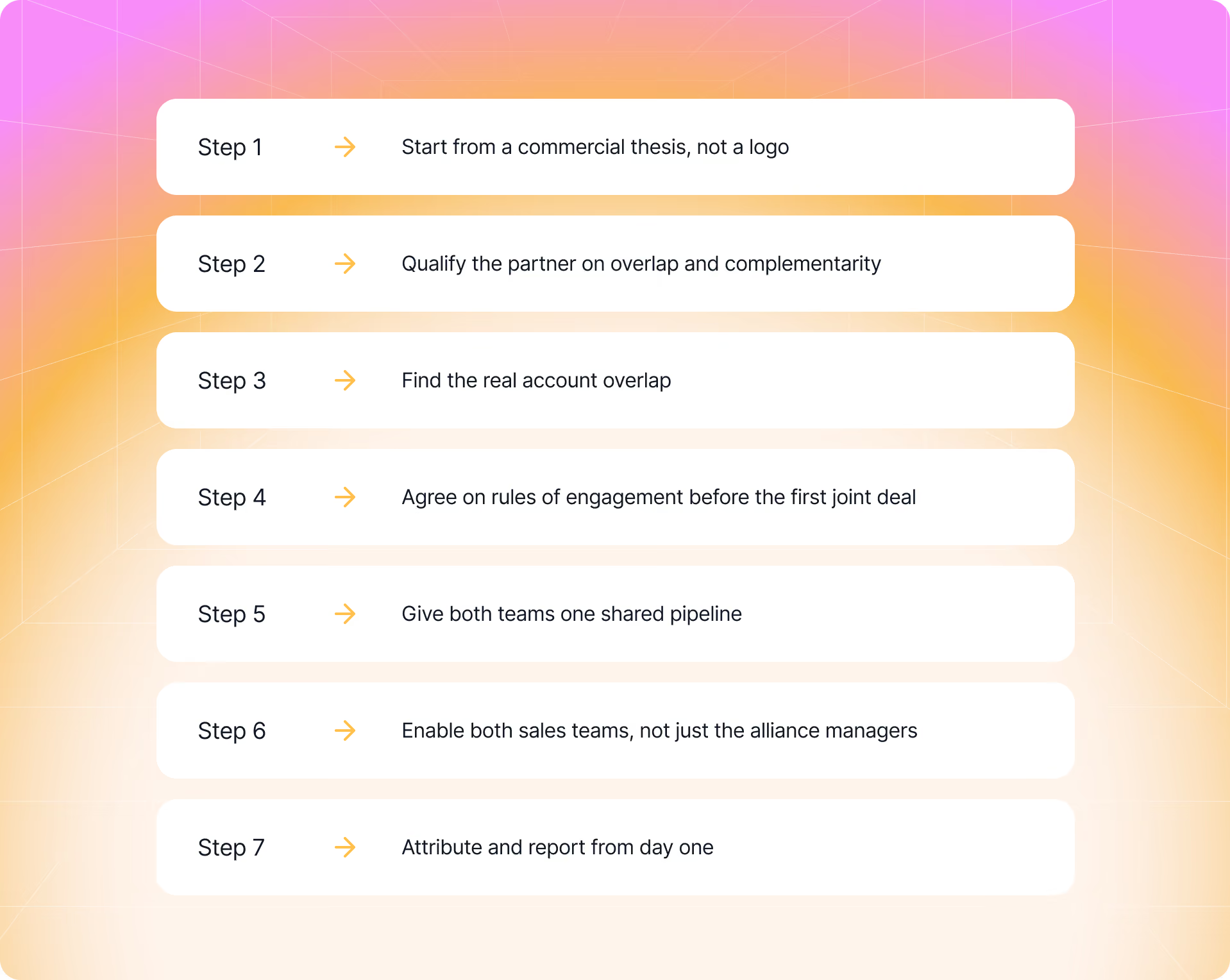
Forming a strategic alliance is the easy part. Turning it into a real business strategy takes deliberate strategic alliance management, not a signature and a press release.
1. Start from a commercial thesis, not a logo
Write down, in one sentence, what each side gains and which customer problem the combination solves. If you can't, what you have is a press release, not a strategic alliance.
2. Qualify the partner on overlap and complementarity
Two questions decide whether such an alliance is worth pursuing. Do you serve the same ideal customer, and will you gain access to something genuinely additive rather than competitive? Potential partners who look similar on paper don't always share the same customer, and companies must align on core competencies before committing.
3. Find the real account overlap
Use account mapping, often through a tool like Crossbeam, to surface which accounts both companies actually touch.
That overlap only helps once it lives where reps already work, whether that's Salesforce or another CRM.
Pairing this with nearbound marketing helps both sides reach shared accounts through trusted channels instead of cold outreach.
4. Agree on rules of engagement before the first joint deal
Define deal leadership, technical support, escalation, and pricing authority, and put it in writing while the relationship is still friendly.
5. Give both teams one shared pipeline
Both sides need to see the joint deals without either company handing out CRM seats to the other's reps, whether that CRM is HubSpot or Salesforce. This is the single biggest operational unlock and also the step most strategic alliances skip.
6. Enable both sales teams, not just the alliance managers
This is where alliance execution overlaps with everyday partner sales. Reps need to know when to bring the partner in and how to position the joint value proposition.
Deal coaching specific to the joint motion is what makes this stick.
7. Attribute and report from day one
Track partner-sourced and partner-influenced revenue in the CRM from the start so the alliance can be defended with numbers instead of narrative.
Potential partners forming a strategic alliance for the first time can use this as a quick checklist. Successful strategic alliances tend to check every box before the first joint deal closes.
- ☐ Write a one-sentence commercial thesis
- ☐ Qualify the partner on overlap, not brand recognition
- ☐ Map real account overlap
- ☐ Set rules of engagement in writing
- ☐ Stand up one shared pipeline
- ☐ Enable both sales teams, not just the managers
- ☐ Attribute revenue from day one
What running an alliance actually looks like
How Introw operationalizes strategic alliances
In Introw, strategic alliance partners are managed as co-sell partners, a full partner org that mirrors your own sales team. The money here is influence and sourcing credit, not resale margin, which is why attribution trust matters more here than almost anywhere else in the partner spectrum.
The moment you sign the deal
Crossbeam surfaces which accounts both companies actually touch, so the joint motion targets real overlap instead of a wishlist.
The moment a rep works a shared deal
The partner's alliance manager or rep works the live opportunity from their own CRM or the Introw partner portal, seeing only the fields you expose, with everything writing back to HubSpot or Salesforce in real time. No CRM seat required.
The moment two teams collide on the same account
AI-based conflict detection flags overlap the second a deal is registered, with an approval gate that resolves it before it turns political.
The moment a rep isn't sure what to do next
Stage-specific deal coaching tells both sides when to bring in an executive or step back and let the other side run point.
The moment budget season arrives
A single pipeline shows partner-sourced versus partner-influenced revenue, defensible inside the CRM your CRO already trusts.
The moment you want to fund joint demand
Market Development Funds tied to the same pipeline context let both sides run co-branded campaigns without a separate approval process for every asset.
The moment the alliance manager needs a quick answer
The partner AI agent lets them check deal status and next steps directly, without logging into a portal.
Introw doesn't create the alliance strategy. It makes a signed alliance executable and measurable, which is usually what determines whether it survives past the first year.
See how a signed strategic alliance turns into shared pipeline and defensible revenue with Introw's co-sell partner type, built to run alongside referral, reseller, and other partner motions.
Ready to try it on your own accounts? Book a demo.
Still curious? Here are some quick answers to help clear things up
Salesforce and AWS are one clear example. The two companies co-innovated an AI product offering that runs on AWS infrastructure, paired with formal co-selling incentives and a joint marketplace listing, without either company merging or creating a new entity.
Partnership is the broader, more casual umbrella term for any ongoing business relationship. A strategic alliance is the formalized, strategic version of that relationship, usually with a defined agreement and shared commercial goals.
Most fail because they're signed at the executive level and never operationalized in the field. Common causes include no shared account list, no rules of engagement, unresolved channel conflict, and no way to attribute revenue back to the strategic alliance when budgets get reviewed.
Measure it the way you'd measure any revenue-generating motion, partner-sourced and partner-influenced revenue tracked directly in the CRM, alongside the joint pipeline the alliance has created.
A co-sell partner is the operational form most strategic alliances take once they're signed. Instead of one company reselling the other's product, two full sales teams work the same shared accounts side by side, splitting sourcing and influence credit rather than resale margin.






Are you already an active Introw partner?
Book a demo with one of our partner program experts, or explore Introw on your own time.