

.svg)


.svg)
.svg)








Articles by Ruben
15 Best ChannelScaler Alternatives for Partner Teams in 2026
What is ChannelScaler (and why do teams seek alternatives)?
ChannelScaler is a partner relationship management (PRM) platform created through the merger of Allbound and Channel Mechanics. It combines deal registration, MDF management, incentives, partner marketing, and through-channel marketing automation in one platform.
For many businesses, that’s exactly what they need.
Others look for deeper CRM integration, a simpler partner experience, stronger automation, or more flexibility as their partner program grows.
Common reasons teams evaluate ChannelScaler competitors include:
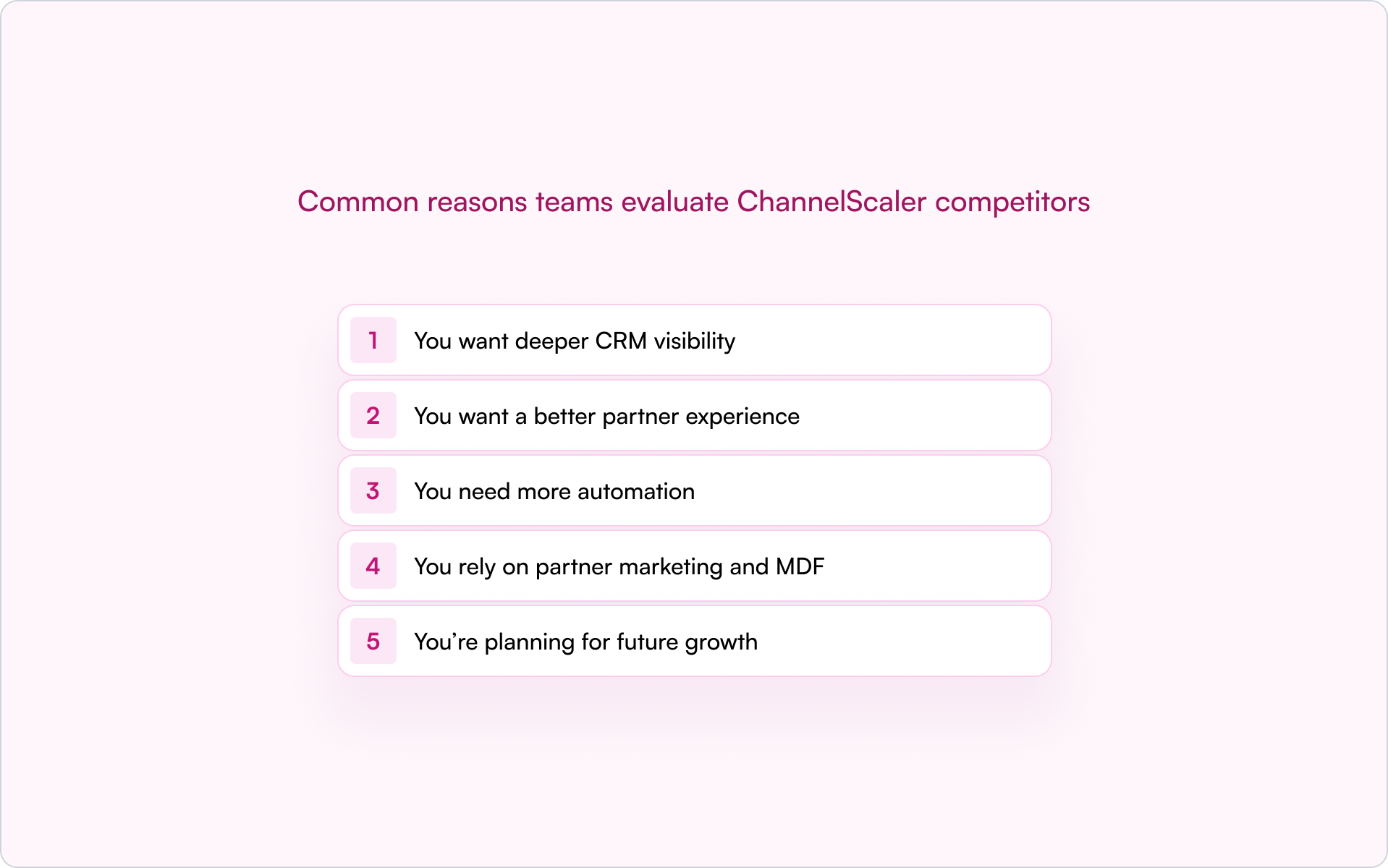
1. You want deeper CRM visibility
Many teams want deal registration, attribution, partner data, and reporting tied more closely to Salesforce or HubSpot.
2. You want a better partner experience
As partner ecosystems grow, adoption matters. Teams often look for ways to reduce friction and make it easier for partners to engage.
3. You need more automation
Automation can reduce manual work across onboarding, approvals, notifications, reporting, and partner operations.
4. You rely on partner marketing and MDF
If MDF management, partner marketing, and through-channel marketing automation are important, it’s worth comparing how each platform supports those workflows.
5. You’re planning for future growth
The right platform should support your partner ecosystem today and continue to scale with your business.
ChannelScaler alternatives at a glance
If you’re shortlisting ChannelScaler alternatives, this table gives you a quick overview of where each platform fits before diving into the detailed reviews.
The right choice depends on your partner program, growth goals, and how your team prefers to work.
The 15 best ChannelScaler alternatives in 2026
Choosing a PRM is often less about features and more about fit. The platforms below take very different approaches to partner relationship management, partner engagement, channel automation, and partner marketing.
1. Introw

What it does:
Introw is a CRM-first partner relationship management platform built for SaaS companies running referral, reseller, and co-sell programs. It keeps partner data, deal registration, attribution, forecasting, and partner operations directly inside Salesforce or HubSpot.
Partners can collaborate through email, Slack, forms, and lightweight portal experiences, helping teams scale partner revenue with less administrative overhead and a more frictionless channel experience.
Why it’s a good ChannelScaler alternative:
While ChannelScaler combines partner management, MDF management, incentives, and channel marketing in one platform, Introw takes a CRM-first approach. It’s a strong fit for teams that want deeper Salesforce or HubSpot integration, AI-powered workflows, faster implementation, and less reliance on a traditional partner portal.
Who it’s best for:
SaaS companies that want to manage their partner ecosystem from Salesforce or HubSpot and improve partner engagement, partner experience, pipeline visibility, and partner-sourced revenue without relying heavily on a traditional partner portal.
Key features:
- Native Salesforce and HubSpot integration with support for custom objects and partner data
- AI-powered deal coaching that delivers guidance, content recommendations, and next steps inside active opportunities
- Deal registration, attribution, forecasting, and reporting built directly around CRM workflows
- Email and Slack-based partner collaboration that reduces portal dependency and improves partner engagement
- MDF management, partner marketing workflows, and partner program automation within a single platform
Pricing:
Custom pricing. Contact Introw for a quote based on your partner program requirements.
2. Impartner
.png)
What it does:
Impartner is an enterprise partner relationship management platform focused on partner onboarding, deal registration, partner engagement, MDF management, and channel automation. It’s designed to help businesses manage complex partner programs from a single platform.
Why it’s a good ChannelScaler alternative:
Impartner offers enterprise-grade partner relationship management, MDF management, incentives, onboarding, and channel marketing capabilities with extensive customization and advanced workflow automation.
Who it’s best for:
Mid-market and enterprise businesses with mature channel sales motions that need advanced workflows, structured partner programs, and strong MDF management capabilities.
Key features:
- Partner onboarding, training, certification, and deal registration workflows
- MDF management with approval processes, reimbursement tracking, and ROI tracking
- Automated partner engagement, reporting, and channel program management
Pricing:
Custom pricing. Contact Impartner for a personalized quote.
3. ZINFI
.png)
What it does:
ZINFI is a partner relationship management and through-channel marketing automation platform designed to support the full partner lifecycle, from recruitment and onboarding to deal registration, partner marketing, incentives, and analytics.
Why it’s a good ChannelScaler alternative:
ZINFI offers broad channel automation capabilities across partner management, MDF management, partner engagement, and channel marketing. It’s a strong fit for businesses managing multiple partners across complex partner programs.
Who it’s best for:
Large partner ecosystems that need end-to-end partner program automation and global channel operations.
Key features:
- Partner onboarding, deal registration, and partner portal management
- MDF management, incentives, and partner performance tracking
- Through channel marketing automation and partner marketing tools
Pricing:
Custom pricing.
4. Unifyr (formerly Zift Solutions)
.png)
What it does:
Unifyr is a partner relationship management platform that evolved from Zift Solutions. It combines partner engagement, channel marketing, training, content management, and partner program automation in one platform.
Why it’s a good ChannelScaler alternative:
Unifyr focuses heavily on partner engagement and partner marketing while offering strong automation across the partner journey. Its AI-powered capabilities are designed to help teams scale partner revenue more efficiently.
Who it’s best for:
Businesses that want partner enablement, training, and channel marketing in a single platform.
Key features:
- Partner portal with onboarding, training, and certification
- AI-powered content recommendations and partner engagement workflows
- Through channel marketing automation and campaign management
Pricing:
Custom pricing.
5. Channeltivity
.png)
What it does:
Channeltivity is a partner relationship management platform focused on helping channel sales teams launch and manage partner programs without lengthy implementations.
Why it’s a good ChannelScaler alternative:
Channeltivity provides core PRM functionality without the complexity often associated with larger enterprise platforms. It focuses on partner experience, deal registration, and partner engagement while maintaining strong CRM connectivity.
Who it’s best for:
Mid-market businesses that want a dedicated PRM with fast deployment and straightforward administration.
Key features:
- Partner portal, onboarding, and deal registration
- MDF management and training modules
- Native Salesforce and HubSpot integrations
Pricing:
- Standard Edition: $1,899/month
- CRM Edition: $2,199/month
6. Magentrix
.png)
What it does:
Magentrix is a Salesforce-centric partner relationship management platform that helps businesses manage channel partners, partner engagement, and deal registration through customizable partner portals.
Why it’s a good ChannelScaler alternative:
Magentrix appeals to businesses that want a Salesforce-native partner portal and tighter control over partner-facing experiences without investing in a larger channel automation platform.
Who it’s best for:
Salesforce-centric organizations that want configurable partner portals and CRM-connected workflows.
Key features:
- Salesforce-native partner portal
- Deal registration and partner onboarding workflows
- Partner content management and reporting
Pricing:
- Essential: $1,500/month
- Advanced: $3,000/month
- Unlimited: Custom pricing
7. PartnerStack
.png)
What it does:
PartnerStack helps SaaS companies recruit, manage, and reward referral, reseller, and affiliate partners. The platform is particularly known for automated payouts and partner recruitment through its marketplace.
Why it’s a good ChannelScaler alternative:
PartnerStack focuses more on growing partner-sourced revenue and managing partner payouts than traditional partner relationship management. It’s often chosen by SaaS companies looking to generate pipeline through referral and affiliate channels.
Who it’s best for:
SaaS companies building referral, affiliate, and reseller programs.
Key features:
- Partner recruitment marketplace
- Automated payouts and commission management
- Deal registration and partner tracking
Pricing:
Starts at approximately $1,520/month.
8. StructuredWeb
.png)
What it does:
StructuredWeb is a partner marketing platform focused on helping brands drive demand through channel partners using automated campaign execution, content distribution, and localized marketing campaigns.
Why it’s a good ChannelScaler alternative:
StructuredWeb is often selected when partner marketing is the primary objective. It offers strong support for campaign execution, content syndication, and through channel marketing automation.
Who it’s best for:
Businesses that rely heavily on channel marketing and partner-led demand generation.
Key features:
- Through channel marketing automation
- Content management and campaign distribution
- MDF management and ROI tracking
Pricing:
Custom pricing.
9. Ansira (formerly SproutLoud)
.png)
What it does:
Ansira helps brands manage distributed marketing programs across large partner networks. The platform focuses on channel marketing, localized marketing campaigns, incentives, and campaign execution while supporting brand consistency across local markets.
Why it’s a good ChannelScaler alternative:
Ansira is a strong choice for businesses that prioritize partner marketing, localized campaign execution, and demand generation across large partner networks.
Who it’s best for:
Businesses with large partner ecosystems that rely heavily on channel marketing and localized campaign execution.
Key features:
- Localized marketing campaigns and campaign execution tools
- Incentives, MDF management, and partner marketing support
- Brand compliance and distributed marketing workflows
Pricing:
Custom pricing.
10. WorkSpan
.png)
What it does:
WorkSpan helps businesses manage strategic alliances, cloud marketplace partnerships, and co-sell programs across major ecosystems such as AWS and Microsoft.
Why it’s a good ChannelScaler alternative:
WorkSpan specializes in ecosystem-led growth and co-sell execution rather than traditional partner portal workflows. It provides visibility into shared opportunities and partner revenue across alliance programs.
Who it’s best for:
Businesses running strategic alliance and co-sell motions with major technology partners.
Key features:
- Co-sell opportunity management
- Marketplace and alliance automation
- Shared pipeline visibility and reporting
Pricing:
Custom pricing.
11. Kiflo
.png)
What it does:
Kiflo is a lightweight partner relationship management platform designed to help businesses launch and manage partner programs with minimal complexity.
Why it’s a good ChannelScaler alternative:
Kiflo focuses on ease of use, partner onboarding, deal registration, and partner engagement rather than enterprise-scale channel operations. It offers a simpler entry point for growing partner teams.
Who it’s best for:
Businesses launching their first partner program or managing a smaller partner ecosystem.
Key features:
- Partner onboarding and deal registration
- Partner portal and commission tracking
- HubSpot and Salesforce integrations
Pricing:
- Core: $399/month (annual billing)
- Plus: Contact sales
- Premier: Contact sales
12. Mindmatrix
.png)
What it does:
Mindmatrix combines partner relationship management, partner marketing, training, sales enablement, and channel automation within a single platform.
Why it’s a good ChannelScaler alternative:
Mindmatrix provides broad coverage across partner enablement, content distribution, training, MDF management, and partner engagement. It is often evaluated by organizations seeking one platform for multiple partner-facing functions.
Who it’s best for:
Businesses that want partner enablement, training, channel marketing, and partner management in one platform.
Key features:
- Partner onboarding, training, and certification
- Content management and sales enablement
- MDF management and partner marketing automation
Pricing:
Contact vendor.
13. PartnerPortal.io
.png)
What it does:
PartnerPortal.io is a HubSpot-focused partner portal platform that helps businesses manage partner onboarding, lead submission, deal registration, and partner communication.
Why it’s a good ChannelScaler alternative:
PartnerPortal.io prioritizes simplicity and fast deployment. It delivers core partner portal functionality without the complexity of larger partner program automation platforms.
Who it’s best for:
HubSpot users that need a simple partner portal and deal registration process.
Key features:
- Native HubSpot integration
- Lead submission and deal registration
- Partner portal and resource management
Pricing:
- Free
- Growth: $249/month
- Enterprise: $499/month
14. impact.com
.png)
What it does:
impact.com is a partnership management platform focused on affiliate, influencer, referral, and creator partnerships. It helps businesses discover, manage, track, and reward partners at scale.
Why it’s a good ChannelScaler alternative:
impact is built around partnership growth and automated payouts rather than traditional channel sales workflows. It’s commonly used to expand partner reach and drive measurable growth through performance-based partnerships.
Who it’s best for:
Businesses investing in affiliate, influencer, referral, and creator programs.
Key features:
- Partner recruitment and discovery
- Automated payouts and incentive management
- Attribution and performance analytics
Pricing:
- Starter: From $30/month
- Essentials: From $500/month
- Pro: From $2,500/month
- Enterprise: Custom pricing
15. Everflow
.png)
What it does:
Everflow is a partnership management platform focused on tracking, attribution, and performance management for affiliate, referral, influencer, and media partnerships.
Why it’s a good ChannelScaler alternative:
Everflow provides deep reporting and attribution capabilities for businesses that prioritize performance tracking, partner revenue measurement, and optimization.
Who it’s best for:
Businesses running large-scale affiliate and performance partnership programs.
Key features:
- Partnership attribution and analytics
- Automated partner management workflows
- Fraud prevention and performance reporting
Pricing:
Custom pricing.
There’s a lot to choose from, and the right platform depends less on features and more on how your partner program works day to day.
To help narrow down your options, here are the key questions worth asking every vendor.
How to evaluate PRM platforms
A good demo can make every platform look similar. The real differences appear when you look at how the system fits your processes, your team, and your long-term goals.
1. Will it fit the way your team already works?
Some vendors expect everyone to work inside a portal. Others are built around Salesforce, HubSpot, email, or Slack.
Ask vendors:
- Where do partner managers spend most of their time?
- How much work happens outside the portal?
- How much manual administration is required?
- How quickly can new users get started?
2. How easy is onboarding for new partners?
Even the best technology won’t help if adoption is low.
As you review vendors, compare the experience against a practical partner onboarding checklist and ask how quickly new partners can start generating opportunities.
A strong onboarding process should help shorten time-to-value while reducing work for your internal team.
You can compare your process against this partner onboarding checklist when evaluating different approaches.
3. Can it support future growth?
Many teams buy for today’s requirements and discover limitations a year later.
Questions worth asking:
- Can it support different partner types?
- Can it support international expansion?
- How easily can workflows be customized?
- What happens as participation grows?
As your partner ecosystem expands, the platform should be able to support new processes and additional stakeholders without becoming harder to manage.
Look for evidence that the vendor can support revenue growth without adding unnecessary complexity.
4. Can you measure what’s working?
Good reporting should answer business questions, not just display activity metrics.
Ask vendors how they track:
- Partner-sourced revenue
- Revenue growth
- Performance trends
- Attribution
- Real-time insights
If reporting requires spreadsheets and manual reconciliation, visibility usually suffers.
5. What does implementation actually involve?
Implementation timelines vary significantly between vendors.
Before making a decision, ask:
- How long does deployment take?
- Are implementation services required?
- What ongoing administration is needed?
- What level of customer support is included?
Reading independent reviews, customer feedback, and a detailed ChannelScaler review can help uncover issues that rarely appear in product demos.
A little extra evaluation now can save a lot of frustration later.
When ChannelScaler is a good choice
ChannelScaler is a strong fit for mature partner programs that need partner onboarding, deal registration, MDF management, incentives, rebates, and through-channel marketing automation in one platform.
ChannelScaler may be a good choice if you:
- Manage a large network of channel partners
- Run complex incentive, rebate, or MDF programs
- Need stronger control over indirect revenue programs
- Want channel marketing and partner management in one platform
- Have the resources for a more comprehensive implementation
For businesses where incentives, partner marketing, and channel operations are central to the partner program, ChannelScaler offers a broad set of capabilities under one roof.
When it’s time to consider a ChannelScaler alternative
ChannelScaler offers a broad feature set, but it won’t be the right fit for every partner team.
Many businesses start exploring alternatives when they want simpler workflows, faster deployment, or a platform that works more closely with their CRM. Others are looking for a lighter partner experience with less reliance on a traditional portal.
Evaluate ChannelScaler competitors if you:
- Want Salesforce or HubSpot to remain the primary system of record
- Need a faster implementation and shorter time-to-value
- Prefer partners to collaborate through email or Slack
- Want simpler administration and fewer moving parts
- Focus heavily on co-sell motions and partner-sourced revenue
- Need more flexibility around how partners engage with your team
This can be particularly valuable for teams investing heavily in partner-led demand generation, MDF programs, and broader partnership marketing initiatives.
The best platform isn’t necessarily the one with the most features. It’s the one that helps your team and your partners work more effectively every day.
Why Introw is the best choice for modern partner teams
Most PRMs help you manage partners. Introw helps you improve how partner programs perform.
Because Introw is built around Salesforce and HubSpot, partner managers spend less time updating systems and more time helping partners close deals.
Deal registration, attribution, forecasting, MDF management, and partner collaboration stay connected to the CRM, creating better visibility across the entire program.
What makes Introw different?
.png)
- CRM-first workflows that improve visibility and reduce manual administration
- AI-powered deal coaching that helps partners move opportunities forward
- AI integrations, including Claude, that support partner enablement and content workflows
- Email and Slack collaboration that reduces dependence on portal logins
- Attribution and forecasting tied directly to partner revenue
Ready to see how a modern PRM works in practice?
Learn more about Introw’s PRM software, and book a demo to see how Introw can help your team increase partner revenue with less complexity and better visibility.
How to Build a Partner Course Portal: Step-by-Step Guide
What is a partner course portal?
A partner course portal is a secure place where partners sign in, access training, and complete structured courses at their own pace.
Instead of sharing files by email or running one-off webinars, your team keeps education in one portal with clear progress tracking and visibility aligned to each partner’s role.
Built for partners, not employees
Most learning systems support internal teams. A partner course portal is designed for external members like resellers, referral partners, and technical partners who need the right knowledge before working with customers.
Many teams set this up inside a dedicated partner LMS to manage course visibility, access rights, and member progress in one place while showing different learning paths to different partner personas.
More than a content library
A basic portal stores documents. A partner course portal guides partners through a learning journey that supports real partner activity over time.
That usually includes:
- onboarding courses
- product education
- technical training
- certifications
- webinars and support material
With structured learning in place, it becomes much easier to track adoption and understand how to measure channel partner training ROI across your partner ecosystem.
A clear structure like this turns scattered education into something partners can actually follow without searching across multiple systems. Once that foundation is clear, it’s easier to see what your portal needs before you start building it.
What a good partner course portal needs
A partner course portal only works if partners can enter easily, find the right course fast, and know what to do next. When those pieces are missing, even strong education gets ignored.
Here are the core building blocks your portal should include from day one.
Secure partner access
Partners need a simple way to sign in without friction. If login feels complicated, members stop using the portal.
Most teams support access through:
- email-based sign-in
- password or passwordless login
- SSO for larger partner organizations
This keeps training protected while making it easy for the right people to enter the portal when they need support or guidance.
Structured courses and learning paths
A strong partner course portal shouldn’t feel like file storage. It should guide partners toward their first meaningful activity.
That usually means organizing courses by:
- partner role
- onboarding phase
- certification track
- product knowledge level
When partners can see what to learn first and what comes next, they move faster toward readiness. Many teams use dedicated partner LMS software to keep course structure clear as their ecosystem grows.
Certifications that show readiness
Certifications give partners a clear signal that they’re prepared to support customers. They also help your team set expectations for selling rights, onboarding milestones, or solution delivery readiness.
Simple certification paths often work best when introduced gradually and tied to real partner activity. Partner certification strategies can help you design milestones that support adoption without slowing partners down early.
Segmented visibility by partner type
Not every partner should see the same education. A good portal lets you control course access based on:
- partner tier
- role
- region
- language
- lifecycle phase
This keeps training relevant and reduces noise, so partners see what matters for their role and stage. It also supports different experiences across referral, reseller, and technical partner journeys.
Progress tracking and reminders
Partners should always know where they are in their learning journey.
Your team should be able to check:
- who enrolled
- who completed courses
- who earned certifications
- where members dropped off
That visibility makes it much easier to improve adoption and understand what’s working across your partner ecosystem.
Once these pieces are in place, building the portal becomes much more straightforward.
So before you create your first course, who exactly are you building the portal for, and what do you want them to achieve first?
Step 1: Define the audience and training goal
Before you build anything inside your partner course portal, take a step back and decide who the training is for and what they should be able to do after finishing it. This sounds simple, but it’s the step most teams skip.
When the audience isn’t clear, the portal turns into a mix of courses that nobody follows from start to finish.
Start with partner type
Different partners need different education. A reseller doesn’t need the same course as a referral partner. A technical partner doesn’t need the same journey as a marketing partner.
Most teams structure training around groups like:
Each group should see only the courses that help them move forward in their role.
Then define the partner role
Inside each partner type, roles matter just as much. Even within the same partner account, sales, technical, and leadership contacts should not see the same learning experience.
When role-based visibility is clear early, your portal stays simple as it grows and supports different experiences across partner personas.
Connect training to a real milestone
Every course should move partners toward something specific. Otherwise, completion rates stay low.
Common milestones include:
- finishing onboarding
- submitting the first deal
- joining co-selling activity
- earning certification
- preparing to support customers
Structured learning improves adoption and makes certification progress easier to track across your ecosystem.
Aligning courses with a broader partner training journey also helps partners know what to do first and what comes next.
With the audience and goal defined, you can start shaping the learning experience partners see when they enter your portal.
Step 2: Design the portal structure around the partner journey
Once you know who your partners are and what they need to achieve, the next step is shaping what they see when they enter your partner course portal. A clear structure helps members find the right course quickly and keep moving forward.
Think of the portal like a guided path, not a storage space.
Start with the entry experience
The first screen partners see should answer one question right away: what should I do first? It should also answer what’s in it for them, so partners can enter the portal and immediately see the next step, the value of completing it, and what unlocks after that.
Most teams organize their homepage around:
- onboarding courses
- certification paths
- product education
- technical training
- recorded webinars
This makes it easy for members to log in, check their next step, and continue learning without searching through folders. Many teams also organize technical docs, marketing assets, and battle cards into persona-specific asset hubs so partners can quickly find what they need without extra navigation.
Companies also manage this structure inside a dedicated partner LMS, where courses stay aligned with partner roles, personas, and lifecycle stages.
Organize training by journey stage
Partners don’t all start in the same place. Some are brand new. Others are ready to sell. Some are already supporting customers.
A simple structure usually follows stages like:
This helps partners move forward step by step instead of guessing what comes next.
Keep training connected to real partner activity
Training works best when it sits close to the actions partners already take.
For example:
- onboarding courses before submitting the first deal
- certification before co-selling access
- technical training before implementation work
- product updates shared through webinars inside the portal
Some teams also structure their portal so course visibility adjusts automatically based on role, region, persona, or lifecycle stage using systems connected through a HubSpot integration. This keeps access simple as your partner ecosystem grows.
When the structure reflects how partners actually work, the portal feels easier to follow from the first login. With that foundation in place, it’s much simpler to decide which courses should come first.
Step 3: Build the first courses
Once your structure is clear, it’s time to add your first courses. Start small. A partner course portal works best when members can move through a few focused lessons instead of working through too much education at once.
Most teams begin with a simple core set.
Start with the essentials
Your first courses should help partners understand how to work with your team and start engaging in real opportunities quickly.
A strong starting set usually includes:
- partner program overview
- product basics
- sales positioning
- deal registration steps
- certification path introduction
These courses give members the knowledge they need before moving into active deal collaboration.
Keep lessons short and modular
Short lessons are easier to complete and easier to update later. Instead of building one long course, break content into smaller modules partners can finish quickly.
For example:
This makes it easier for partners to check progress, return later, and continue learning without friction.
Use quizzes where readiness matters
Quizzes help confirm that partners understand important steps before moving forward. They’re especially useful before certification milestones or selling access.
Many teams also connect quizzes to broader certification paths using structured approaches like these partner certification strategies, which help reinforce learning across the partner journey.
Starting with a small set of practical courses keeps your portal clear and usable from day one. Once those courses are in place, the next step is deciding which ones should lead to certification.
Step 4: Add certifications and completion logic
Certifications turn a partner course portal from simple education into something partners take seriously. When members know they’ll earn proof of completion, they’re more likely to log in, finish lessons, and move forward.
They also help your team confirm who’s ready to work with customers and participate in real partner activity.
Choose which courses should lead to certification
Not every course needs a certificate. Focus on the ones tied to real partner responsibilities.
Common examples include:
- onboarding completion
- product readiness
- sales positioning
- technical setup training
These checkpoints make it easier to see which members are prepared before they enter customer conversations or support projects.
Use certifications to control access and rights
Certifications aren’t just recognition. They help define what partners can do next.
For example, your team can connect completion to:
- permission to register deals
- access to advanced education tracks
- eligibility for co-selling
- expanded partner program rights
Many teams introduce certifications gradually so partners can move into real opportunities early and continue learning as they progress.
If you’re planning a structured rollout, tools with a built-in Salesforce integration make it easier to track completion across partner contacts without managing updates manually.
Make completion visible and easy to track
Partners should always know what they’ve finished and what comes next. A simple dashboard inside the portal helps members check progress after they sign in with their email, reset a password if needed, and return to continue learning.
Your team should also be able to see:
- who enrolled
- who completed courses
- who still needs support
- who is ready for the next stage
This keeps education aligned with real partner activity instead of guessing who’s prepared.
Once certifications are in place, the next step is deciding which partners should see which courses in the first place.
Step 5: Set visibility and enrollment rules
Once your courses and certifications are ready, the next step is deciding who can see what inside your partner course portal. This is what keeps education relevant instead of overwhelming.
When members log in, they should only enter the courses that match their role and responsibilities. That makes the learning journey feel clear from the start.
Control course access by partner attributes
Not every partner needs the same training. Visibility rules help your team give the right education to the right members at the right time.
Most portals segment access using:
- partner type
- partner tier
- region or language
- lifecycle phase
- certification status
This keeps advanced courses hidden until partners are ready and reduces noise when new members enter the portal for the first time.
Clear visibility rules also help maintain program structure as your ecosystem grows alongside the rest of your partner relationship management software.
Choose the right enrollment method
Enrollment decides how members get access to courses after they sign in.
Common options include:
- manual enrollment for small partner groups
- bulk enrollment during rollout
- automatic enrollment based on role or region
- certification-triggered enrollment into advanced tracks
Automatic enrollment helps partners move between program stages without extra support and keeps learning aligned with real partner activity.
In more advanced portals, courses, assets, and program steps can also unlock automatically as partners complete milestones like onboarding tasks or deal registration, creating a guided journey without manual updates.
Some teams also connect enrollment to structured certification paths using modern partner certification software, which helps education stay aligned with readiness milestones.
With visibility and enrollment rules in place, your portal stays organized as more members join. The next step is rolling it out and making sure partners start using it.
Step 6: Launch, enroll partners, and track adoption
Once your partner course portal is ready, the goal is simple. Help members enter quickly, understand what to learn first, and start engaging without confusion.
A smooth launch makes a big difference in whether partners actually log in and complete their education.
Many teams start with a minimal portal that surfaces deal visibility, reports, and a small set of core courses first, then expand education as partners begin engaging in real opportunities.
Invite members with a clear first step
When partners receive their invitation, they should immediately know how to enter the portal and what to do next.
A strong rollout usually includes:
- a welcome email with login instructions
- a simple way to set or reset a password
- one clearly recommended first course
- a short explanation of why the training matters
This removes friction and makes it easier for members to return later without needing extra support.
Roll out training in small groups if needed
If your ecosystem is large, invite partners in stages instead of all at once. This helps your team answer questions faster and improve the experience before expanding access.
Many teams begin with:
- new partners in onboarding
- active resellers preparing for certification
- technical contacts supporting customers
Structured certification rollouts like these often improve completion rates over time, especially when paired with guidance from programs designed to improve partner engagement with certification programs.
Track how members use the portal after launch
After partners enter the portal, tracking activity helps your team understand what’s working.
Start by checking:
- who logged in
- which courses members completed
- where partners stopped learning
- who earned certifications
This makes it easier to adjust course structure and strengthen adoption using proven approaches like the LMS benefits for channel partner certification.
A thoughtful rollout helps partners feel confident from their first login. Once the portal is live, it becomes much easier to avoid the common mistakes teams run into when building partner training environments.
Common mistakes when building a partner course portal
Most partner course portals don’t fail because of the platform. They fail because members can’t tell what to do first.
Here are the mistakes that slow adoption most.
Adding too much education too early
Uploading every webinar and document at once makes it harder for members to start.
Begin with:
- onboarding basics
- product overview
- sales positioning
- certification path entry points
You can expand later as partners move into real opportunities.
Building one experience for every partner
Referral partners, resellers, and technical teams need different education. Segmented visibility helps members enter the right learning path from the first login and supports different experiences across partner roles.
Skipping certifications
Without certifications, it’s harder to confirm readiness. Even simple certificates create structure and improve completion when they’re connected to real partner activity.
Treating the portal like a document library
A partner course portal should guide a journey, not store files.
That means:
- clear course order
- structured milestones
- visible progress tracking
- defined completion goals
Launching without enrollment logic
If members don’t know what to take first, they often stop early. Automatic enrollment based on role, region, or certification stage keeps learning clear without manual work.
Many teams moving away from standalone tools explore structured options like these LearnUpon LMS alternatives to simplify partner education as their ecosystem grows.
Avoiding these mistakes keeps your portal easier to manage and easier for partners to use from day one.
With the structure in place, it helps to see how teams build and manage a partner course portal faster inside a single environment.
How Introw helps teams build partner course portals faster
Many teams try to build a partner course portal by combining separate tools for courses, certifications, access control, and tracking. That setup works early on, but it gets harder to manage as partner programs expand across roles, personas, and regions.
Introw LMS brings portal structure, education, certifications, and partner access together in one place so your team can launch quickly without stitching systems together.
Instead of starting from scratch, your team can create structured learning experiences based on partner role, lifecycle stage, or persona, while keeping visibility aligned with real partner activity inside the CRM.
Many teams begin with CRM-based visibility and deal context first, then layer courses and certifications afterward so the portal can go live quickly using data they already have.
Members log in and immediately see what they should learn first, what they can access next, and when they’re ready to move forward without searching across tabs or tools.
Because courses, certificates, and visibility rules stay connected, your team can:
- assign training by partner tier, role, or persona
- enroll members automatically as they progress
- issue certificates as milestones are completed
- adjust access rights as partners move into new program stages
Visibility can also update automatically using CRM attributes like certification status, geography, pipeline access, or lifecycle stage.
Teams moving away from fragmented learning tools often explore structured platforms like these 360Learning alternatives to keep partner education aligned as their programs grow.
When training, access, and certifications live inside the same partner environment, your portal becomes easier to launch and far easier to maintain.
And once the system is simple for your team, it becomes much easier for partners to log in, learn what matters, and move into real opportunities with confidence.
Over to you
A strong partner course portal gives your partners a clear place to enter, learn what matters first, and move toward their first real opportunities with confidence.
When courses, access, and progress tracking are structured from the start, training stays aligned with partner roles and becomes much easier to manage as your program grows.
Three simple next steps to get started:
- choose which partner roles need training first
- build a small set of core onboarding and product courses
- set visibility rules so members only see what applies to them
Starting small helps partners engage earlier and continue learning as they move into active deal collaboration.
If you want to see how teams set this up inside a single partner environment connected to their CRM, request a demo to get started.
9 Best Practices for SaaS Partner Content Programs in 2026
Partners can’t sell what they don’t understand. Yet most SaaS partner programs still “enable” partners by handing over a few outdated PDFs, linking to a cluttered Google Drive, and hoping partner-sourced pipeline magically appears.
A strong partner content program changes the equation. It gives partners the materials they actually need — organized, accessible, and mapped to how they sell — so they can represent your product without constant hand-holding. In this guide, we’ll walk through the best practices for SaaS partner content programs in 2026, from identifying what’s missing to proving which assets drive revenue.
What is a SaaS partner content program?
A partner content program is the collection of enablement materials, sales collateral, co-marketing assets, and training resources you create specifically for partners to use when selling or implementing your product. The best programs go beyond “upload and hope” — they co-create tailored, high-value assets (case studies, webinars, whitepapers) that highlight joint solutions for shared target audiences.
Unlike internal sales content, partner content is built for an external audience. Your partners don’t have the same product context your AEs do, and they’re often juggling multiple vendors at once. That means your content has to be clearer, more findable, and easier to reuse.
- Enablement content: Product training, battle cards, and objection handling guides
- Sales collateral: Pitch decks, one-pagers, and ROI calculators partners can use with prospects
- Co-marketing assets: Co-brandable templates, campaign kits, and joint webinar materials
- Technical resources: Integration docs, implementation guides, and API references
Why partner content programs matter for SaaS growth
A signed partnership isn’t a growth channel by default. It becomes a growth channel when partners can confidently position, sell, and deliver your product without needing your team in every conversation.
Content is the link that turns a partner agreement into active, revenue-generating behavior — and it does it at scale.
- Faster partner ramp: Partners close deals sooner when they have ready-to-use materials
- Consistent messaging: Your value proposition stays intact across every partner conversation
- Reduced support burden: Self-serve content means fewer questions hitting your partner team
- Scalable co-selling: Content enables partners to act as an extension of your sales team
The 9 best practices for SaaS partner content programs
If you’re building this as a founder or early revenue leader, the goal isn’t “more content.” The goal is the smallest set of assets that helps partners create pipeline — and the operating system to keep those assets current, discoverable, and measurable.
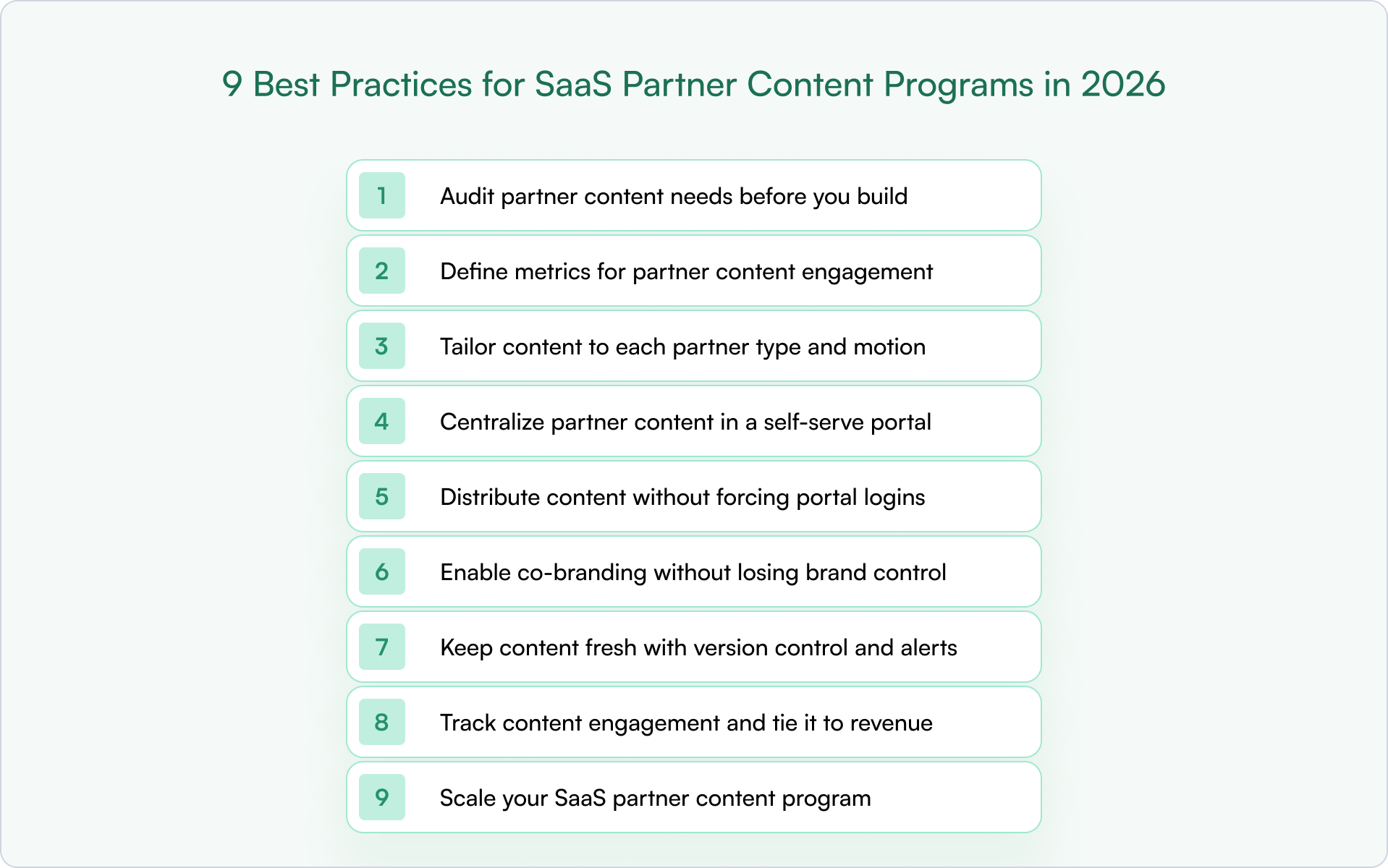
1. Audit partner content needs before you build
Before you write a single new deck, validate what partners actually need. Many partner programs burn time creating content that never gets used because it doesn’t solve a real selling problem.
Interview partners about content gaps
Ask your existing partners what’s missing, what’s outdated, and what they wish they had. Keep the conversation grounded in real deals: what stops them from moving a prospect forward or answering questions with confidence?
Even five conversations usually reveal patterns. For example, partners might not want another product overview — they might need a competitive comparison they can forward when a prospect is evaluating alternatives.
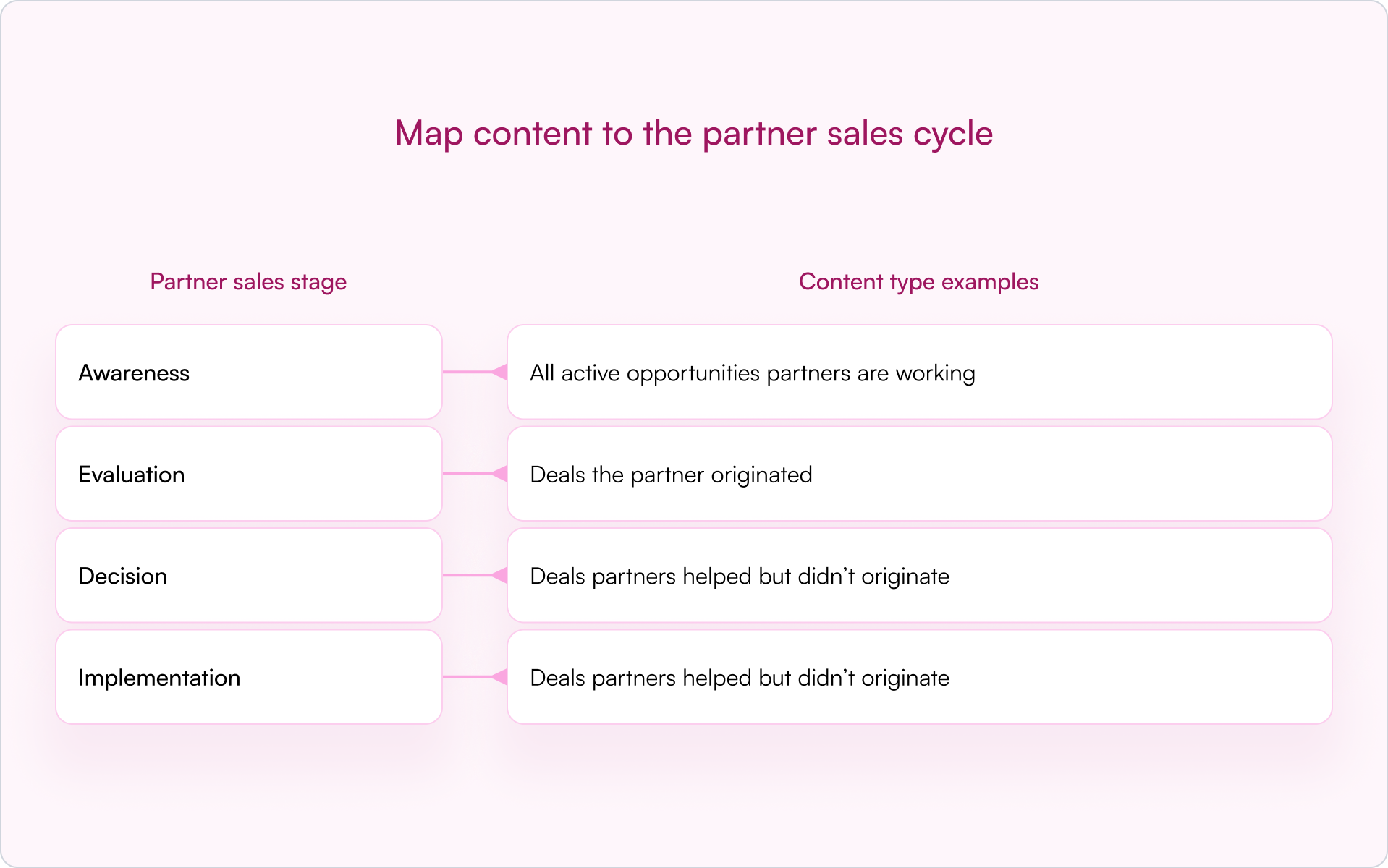
Map content to the partner sales cycle
Different stages of the partner-led sales cycle require different assets. Awareness-stage conversations benefit from solution briefs and intro decks. Evaluation calls for competitive comparisons and demo videos. Decision-stage deals often hinge on ROI calculators and customer stories. Implementation requires technical guides and onboarding checklists.
Also consider your partner model. Referral, reseller, and systems integrator motions typically need different content at each stage.
Identify high-value assets vs. nice-to-haves
Prioritize ruthlessly. Start with content that directly impacts deal velocity — battle cards, pricing guidance, and objection handling. Save high-effort production (heavy video, glossy campaigns) until the essentials are working.
2. Define metrics for partner content engagement
You can’t improve what you don’t measure. If you want partner content to be treated like a growth lever (not a cost center), set up tracking from day one.
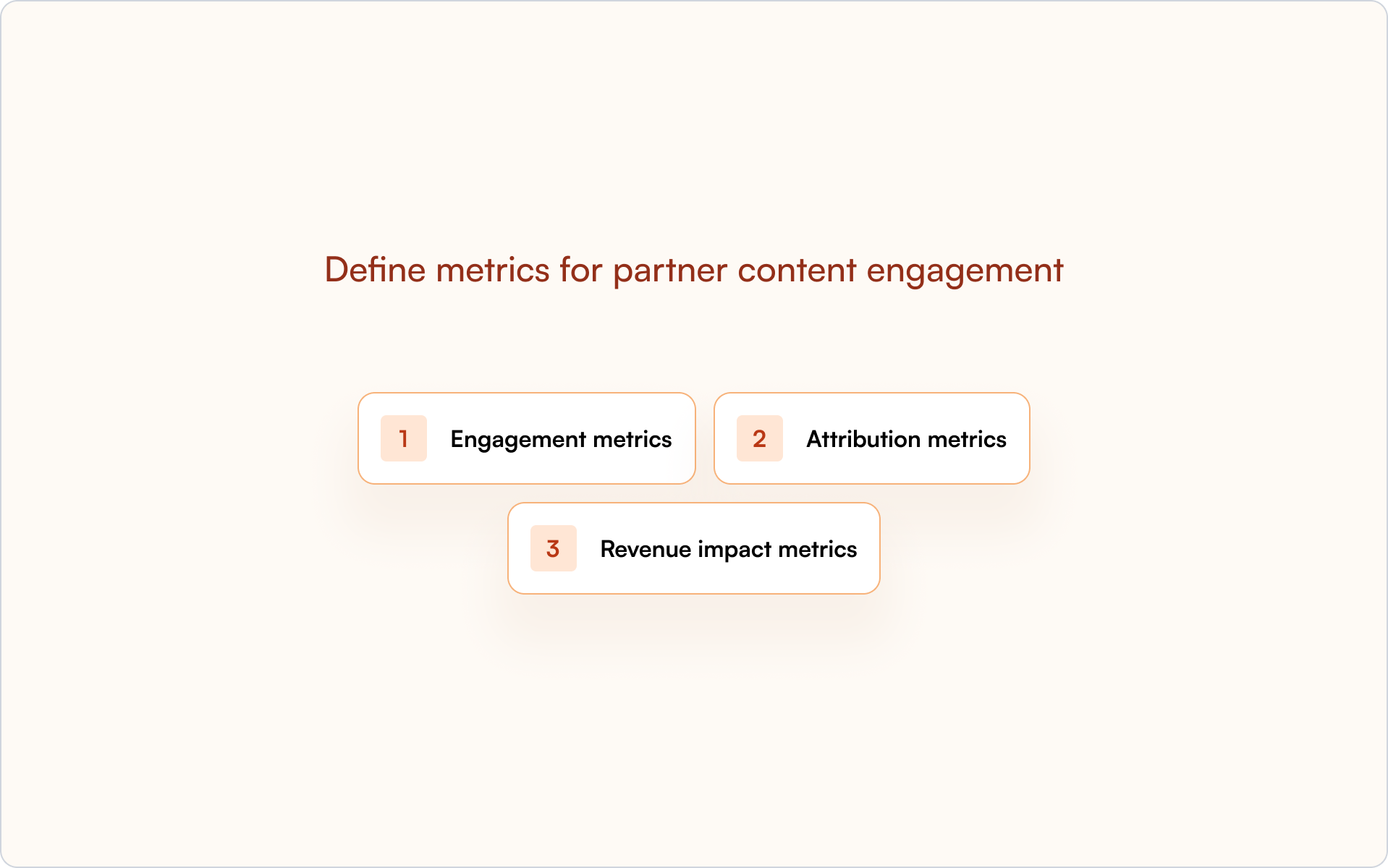
Engagement metrics
Track views, downloads, shares, and time spent on each asset. This is your early signal for what’s useful versus what’s ignored.
Attribution metrics
Go beyond engagement by connecting content consumption to deal registration and pipeline generation. For example: did partners who used a specific battle card register more deals, or move deals to the next stage faster?
Revenue impact metrics
The gold standard is tying content engagement to closed-won revenue. Identify which assets consistently appear in the journey of deals that close — then reinvest in what’s working and prune what isn’t.
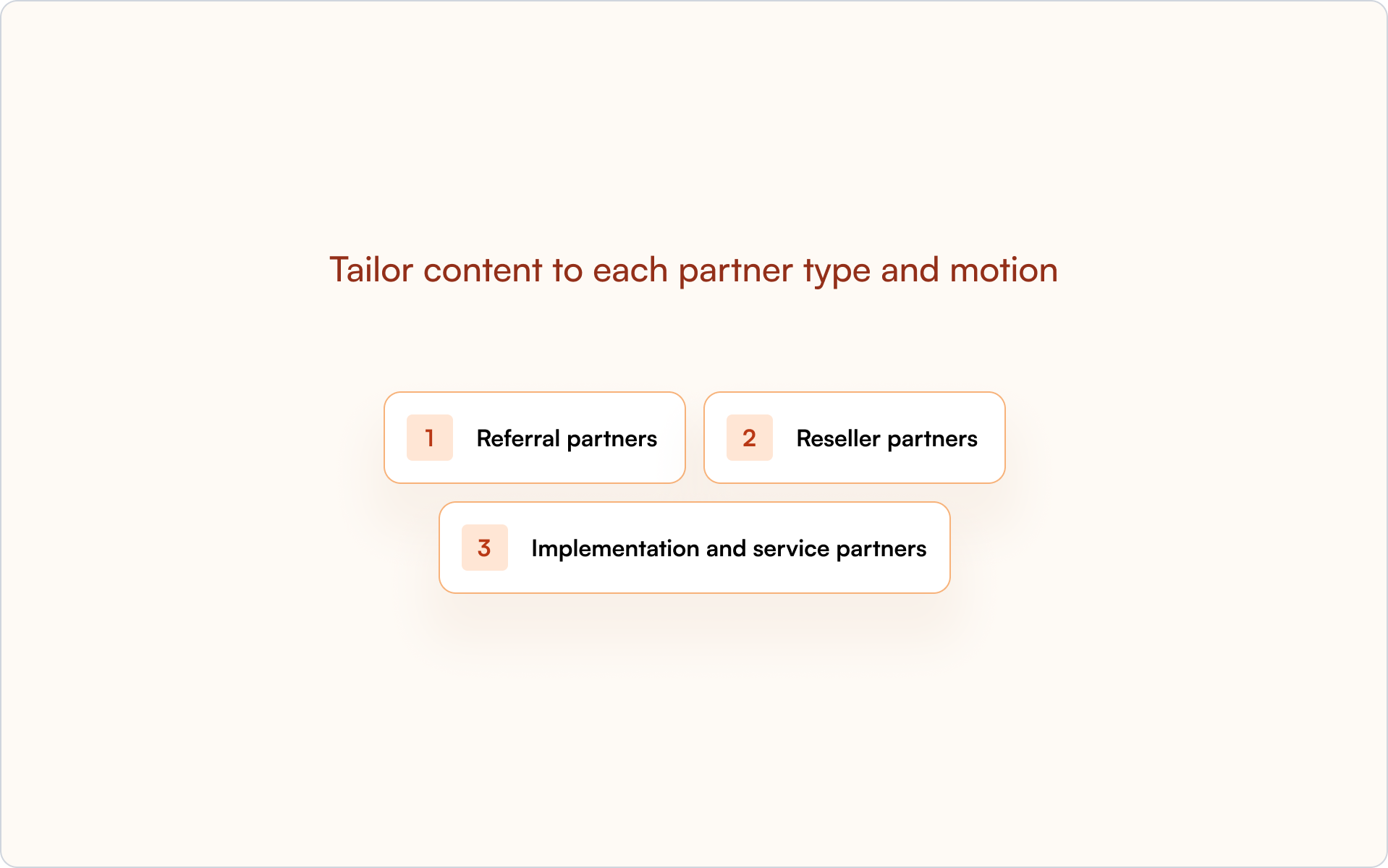
3. Tailor content to each partner type and motion
One of the most common reasons partner content programs underperform: every partner gets the same folder of assets. But a referral partner and a reseller are doing fundamentally different jobs — so they need different materials.
Referral partners
Optimize for speed and shareability: one-pagers, pre-written email templates, and landing pages they can forward to prospects. Referral partners typically don’t need deep product training — they need to qualify opportunities and hand them off cleanly.
Reseller partners
Resellers need full sales enablement: comprehensive pitch decks, demo scripts, pricing calculators, and objection handling guides. If they own the sales cycle, your program has to help them sound like experts quickly.
Implementation and service partners
Prioritize technical documentation, implementation playbooks, and certification materials. These partners deliver value post-sale, so your content should reduce delivery risk and improve time-to-value.
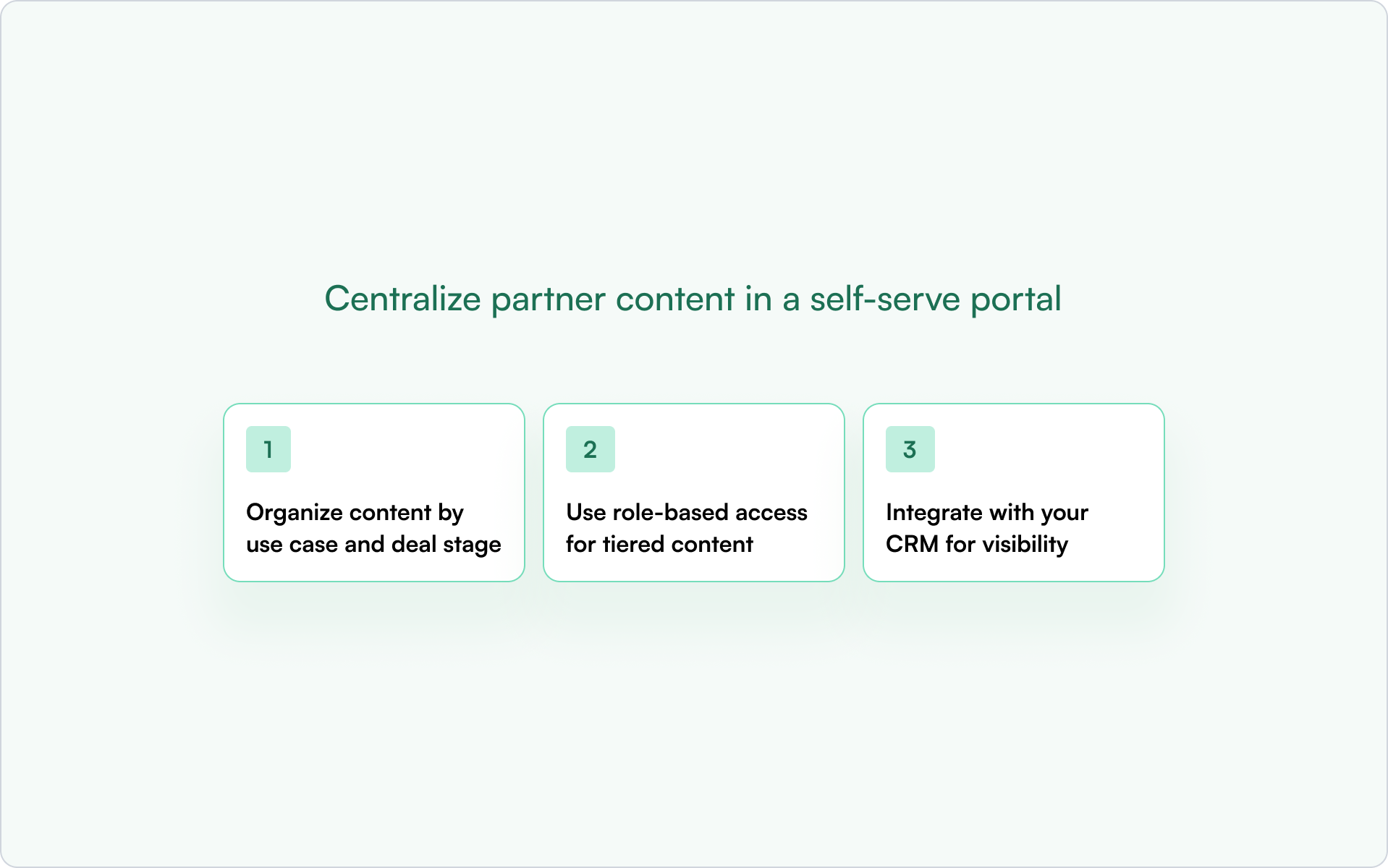
4. Centralize partner content in a self-serve portal
Partners won’t hunt through old email threads or shared drives. A centralized portal makes assets discoverable and ensures everyone is working from the same version.
Organize content by use case and deal stage
Structure the portal so partners can find what they need in seconds. Organize by “I’m trying to…” use cases — not your internal folders. A partner looking for a competitive comparison shouldn’t have to guess whether it lives under “Marketing > Collateral > Q3.”
Use role-based access for tiered content
Not every partner should see everything. Gate advanced content — pricing details, product roadmaps, competitive intelligence — behind certification or partner tier status. Done well, this also creates a healthy incentive for partners to level up.
Integrate with your CRM for visibility
When your portal connects to HubSpot or Salesforce, you can see which partners access which content and tie engagement back to pipeline. A CRM-first approach keeps this data visible to your revenue team — not trapped in a separate system.
5. Distribute content without forcing portal logins
Here’s the reality: many partners won’t log into your portal regularly. The best practices for SaaS partner content programs assume that, and they meet partners where they already work — inbox, Slack, and direct links.
Push content via email and Slack alerts
Don’t wait for partners to “check the portal.” Proactively send new or updated content through channels they use daily. A quick Slack message with a direct link to a new battle card beats hoping they stumble on it later.
Enable off-portal access for key assets
When possible, allow partners to access critical assets without authentication. Removing friction matters most in high-pressure moments — like five minutes before a discovery call.
Capture engagement without requiring authentication
Use trackable links or lightweight forms so you can still see what’s being used, by whom, and when — without adding password friction.
6. Enable co-branding without losing brand control
Partners want to put their logo on your materials. You want your messaging (and legal disclaimers) to stay accurate. The compromise is to design co-branding into the system — not bolt it on later.
Set co-branding templates and guardrails
Create templates with clearly defined editable zones (partner logo and contact info) and locked zones (product messaging, positioning, disclaimers). Make the rules obvious so partners can move fast without breaking your brand.
Automate partner logo insertion
Where possible, use dynamic templates that auto-populate a partner’s branding based on who’s logged in. This reduces manual edits and avoids “wrong-logo” mistakes.
Review and approve workflows
For high-stakes assets — customer-facing decks, public case studies, press releases — include an approval step. Automate what you can, but protect brand integrity where it matters.
7. Keep content fresh with version control and alerts
Outdated content is worse than no content. It creates confusion, slows deals, and erodes partner trust. Maintenance needs to be part of your operating rhythm — not a once-a-year cleanup.
Set refresh cadences by content type
Define review cycles and put them on a calendar. For example: review pricing quarterly, update product docs after each release, and refresh competitive intel monthly.
Sunset outdated assets automatically
Archive or hide assets past their expiration date. Partners shouldn’t accidentally pull last year’s pricing sheet the night before a proposal goes out.
Notify partners when content is updated
When you update an important asset, tell partners immediately. Email or Slack notifications keep everyone aligned on the latest version.
8. Track content engagement and tie it to revenue
If you want partner content to earn ongoing investment, you need to show how it impacts pipeline and revenue — not just downloads.
Measure views, downloads, and shares
Engagement metrics show what’s popular. Track at both the asset level and the partner level to identify high-performing content and your most engaged partners.
Connect engagement to deal progression
Look for patterns that correlate with movement: when a partner downloads an ROI calculator and then registers a new deal, you want that sequence visible. Build reporting that makes content a measurable part of deal velocity.
Report content ROI in partner QBRs
Bring content engagement data into quarterly business reviews. It’s one of the fastest ways to align on what’s working, what’s missing, and what you should build next together.
9. Scale your SaaS partner content program
What works with ten partners breaks at one hundred. Scaling a partner content program requires automation, personalization, and strong self-serve foundations — otherwise your partner team becomes a content concierge.
Automate content distribution workflows
Trigger content based on milestones: completing a certification, registering a first deal, entering a new tier, or launching a joint campaign. Automation keeps the partner experience consistent as volume grows.
Use AI for personalization at scale
AI can recommend the most relevant assets based on partner type, deal stage, and past engagement. Relevance drives usage — and usage drives revenue.
Reduce manual content requests with self-serve
Repeated partner requests for the same asset usually mean it’s not findable. Treat every manual request as product feedback on your portal’s organization, then close the gap.
Conclusion: make partner content a growth system, not a folder
The best practices for SaaS partner content programs aren’t about producing more collateral. They’re about building a repeatable system: the right assets for each partner motion, delivered where partners actually work, kept current with version control, and measured against pipeline and revenue.
If you get those fundamentals right, your partners stop feeling like a channel you have to manage — and start acting like a go-to-market multiplier.
Build your SaaS partner content program with Introw
Introw’s CRM-first partner portal helps teams centralize, distribute, and track partner content — all inside HubSpot or Salesforce.
- Content hosting directly in the portal
- Announcements to push updates via email and Slack
- Engagement tracking that syncs to CRM records
- Off-portal access so partners don’t always need logins
Get a demo to see how Introw helps SaaS partner programs deliver content partners actually use.
Partner Management Automation in 2026: How to Automate Partner Workflows
Partner management automation is the use of software to handle repetitive partnership workflows — deal registration, partner communication, onboarding, and reporting — without manual intervention. In 2026, the teams that scale partner revenue the fastest aren’t the ones with the most portal features. They’re the ones that remove friction for partners while keeping everything measurable for the revenue team.
The most effective approach is CRM-first: automation that enhances your existing HubSpot or Salesforce instead of creating a separate system that hides partner activity.
Manual partner management works fine with a handful of partners. It breaks down fast when you’re chasing updates across fifty partners, copying data between systems, and watching engagement drop because nobody wants to log into another portal.
This guide covers what you can automate, how to implement it step by step, and how to choose partner management software that keeps everything visible inside your CRM.
What is partner management automation?
Partner management automation refers to using software to handle repetitive partnership tasks without manual intervention. Instead of chasing partners for updates, tracking deals in spreadsheets, or manually routing approvals, automation runs the workflow inside your existing systems — with clear ownership, timestamps, and reporting.
In practice, partner management automation typically covers four areas:
- Deal and lead registration: Partners submit opportunities through forms or email, and the system auto-routes for approval, timestamps decisions, and syncs everything to your CRM.
- Partner communication: Triggered emails, Slack notifications, and announcements go out automatically when deals change status, policies update, or registrations expire.
- Pipeline visibility: Dashboards update in real time from CRM data, so sales, partnerships, and RevOps see the same reality.
- Onboarding workflows: Welcome sequences, task checklists, and document collection happen without manual coordination.
The key distinction is where automation lives. Traditional PRMs often create a separate system that hides partner activity from your CRM. CRM-first automation keeps everything visible inside HubSpot or Salesforce, so partner-sourced revenue is trackable and forecastable alongside direct sales.
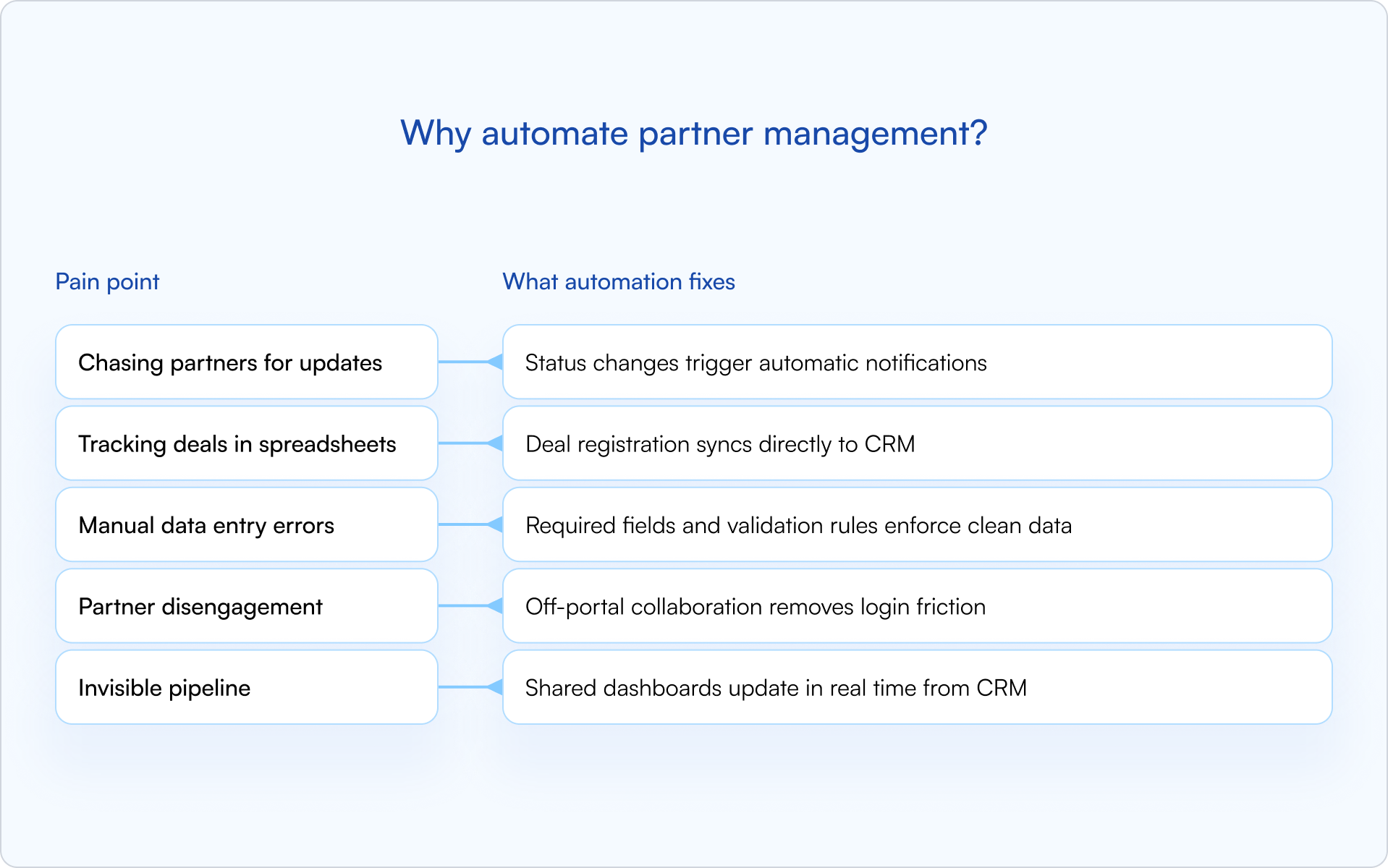
Why automate partner management?
Manual partner management works fine with five partners. It breaks down quickly at fifty — especially once you’re dealing with approvals, attribution questions, and a pipeline that leadership wants to forecast.
The pain points are predictable: chasing partners for deal updates, copying data between systems, correcting duplicate records, and watching engagement drop because partners don’t want to log into another portal. Meanwhile, leadership can’t forecast partner revenue because the pipeline is invisible.
The outcome is simple: automation removes the friction that slows everything down. You can grow from twenty partners to three hundred without proportionally scaling headcount, because repetitive work is handled automatically and consistently.
Partner management tasks you can automate
Not every task benefits equally from automation. The highest-impact workflows are the ones that are high-volume, repetitive, and prone to human error — the exact places where a founder-led partnerships function starts to crack as you scale.

Deal and lead registration
This is where most teams start, and for good reason. Manual deal registration creates delays, disputes, and dirty data.
With automation, partners submit deals through a form or email. The system auto-routes the submission for approval, timestamps the decision, and syncs the deal to your CRM. Protection windows are enforced automatically, and expiring registrations trigger reminders before they lapse.
Deal registration is also your primary defense against channel conflict. When ownership is established early and visible to everyone, disputes become rare.
Partner communication and announcements
Partners miss updates when communication depends on someone remembering to send an email. Automation makes “the right update at the right time” the default.
Trigger notifications for the moments that matter: deal status changes, policy updates, expiring registrations, and approval decisions. Notifications can go out via email, Slack, or in-portal announcements — whichever channel your partners actually check.
Off-portal collaboration is a major lever here: partners can reply to notifications via email, and responses sync back to the CRM timeline. No login required.
Pipeline visibility and reporting
Shared pipeline views give partners visibility into their deals without exposing sensitive pricing or internal notes.
Property-level controls let you decide exactly what partners see (stage, next step, protection expiry) while keeping discount bands and internal comments hidden. Dashboards update automatically from CRM data, so you’re not manually pulling reports.
Partner onboarding and enrollment
Onboarding is a repeatable process — and repeatable is exactly what automation is good at. Onboarding new partners involves a predictable sequence: welcome emails, document collection, profile creation, and task assignments.
Automation runs that sequence without manual coordination. Partners receive welcome content, complete required steps, and get provisioned in your CRM, all triggered by enrollment. SSO removes password friction so partners can access the portal immediately.
Partner enablement and training
Training assignments can be automated based on partner tier, certification status, or product focus.
Content lives in the partner portal, completion is tracked automatically, and reminders go out when certifications expire. Partners stay ready to sell without requiring your team to manually assign and follow up on every course.
Payouts and commissions
For programs with referral or reseller commissions, automation can calculate payouts based on deal stage, generate reports for finance, and trigger disbursements.
Payout automation depends heavily on your partner model. Not every program needs it, but for programs that do, automation eliminates the back-and-forth between partner managers, finance, and partners.
How to implement partner management automation
Partner management automation works best when it’s introduced deliberately, not all at once. The goal is to automate what’s repetitive, protect what’s sensitive, and keep the pipeline trustworthy.
1) Audit your current partner workflows
Start by mapping where manual work lives today. Which tasks involve copying data between systems? Where do partners get stuck? What causes the most friction for your team?
Common culprits include deal registration, status updates, onboarding, and reporting. Document pain points before selecting tools or building workflows.
2) Identify high-impact automations first
Not everything deserves automation on day one. Focus on workflows that are high-volume, repetitive, and error-prone.
Deal registration and status notifications are usually the best starting points. Both are frequent, both directly impact partner engagement, and both create clean CRM data that benefits everyone downstream.
3) Select a CRM-first partner management platform
The platform you choose determines whether automation enhances your CRM or creates a parallel system you’ll be reconciling forever.
Look for:
- Native HubSpot or Salesforce integration: Real-time sync, not batch imports.
- Off-portal collaboration: Partners can take action via email without logging in.
- Property-level sharing: Control exactly what partners see in shared pipeline views.
- Fast implementation: Days to weeks, not months.
A CRM-first approach keeps partner activity visible where revenue teams already work — which is what makes attribution and forecasting realistic instead of aspirational.
4) Configure workflows and launch
Set up deal registration forms, approval routing, notification triggers, and shared pipeline views. Then test with a small partner cohort before rolling out broadly.
Start simple. You can add complexity later once the foundation is working and your team trusts the data.
5) Measure results and iterate
Track partner engagement, registration volume, approval times, and pipeline accuracy. Metrics tell you whether automation is working and where to refine.
The goal isn’t perfect automation on day one. It’s continuous improvement based on what you learn.
Best practices for partner management automation
Automation can backfire if it creates friction instead of removing it. These principles help keep your partner program scalable without making it feel robotic.
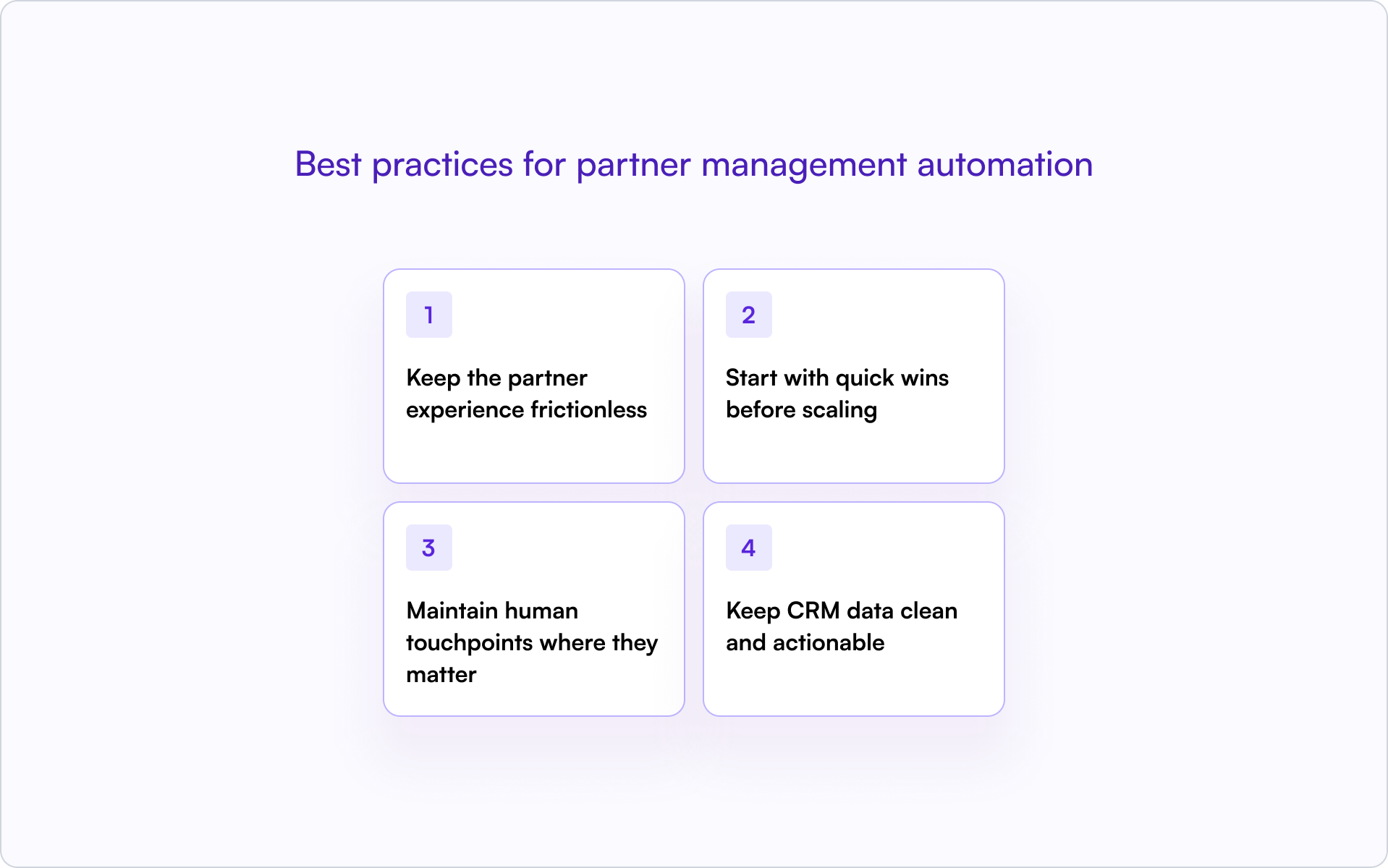
Keep the partner experience frictionless
Portal login walls kill engagement. The moment partners hit a login screen, many stop — especially when registering a deal is “nice to have” compared to running their own pipeline.
- Let partners submit deals via email or lightweight forms.
- Push notifications through channels they already check.
- Enable off-portal collaboration so partners can respond without logging in.
The fewer clicks required, the higher the engagement.
Start with quick wins before scaling
Prove the value of partner management automation with one or two workflows before expanding. Early wins build internal trust and help partners see the system as a benefit, not bureaucracy.
Deal registration is usually the best starting point. It’s visible, it’s frequent, and it creates immediate value for partners and your team. Once deal registration is working, expand to training, payouts, or complex routing.
Maintain human touchpoints where they matter
Automation handles repetitive work. Strategic relationships still require personal attention.
Use automation to free up time for high-value conversations like QBRs, conflict resolution, and partner development. The goal is to spend less time on data entry and more time on relationships.
Keep CRM data clean and actionable
Automation is only as good as the data it runs on.
Set up validation rules, duplicate detection, and required fields to maintain a single source of truth. When partner data is clean, reporting is accurate, attribution is clear, and forecasting becomes possible.
Partner management software for automation
The partner management software landscape includes several categories, each with different trade-offs. If you’re a founder choosing a direction, the real question is: “Will this make partner revenue more visible in our CRM — or less?”
CRM-native partner management platforms
CRM-native platforms are built directly on HubSpot or Salesforce. Partner activity syncs in real time, attribution lives in the same system as direct sales, and forecasting doesn’t require exporting data from a separate portal.
Introw is an example of a CRM-first approach. The partner portal, deal registration, and shared pipeline all live on top of your existing CRM, with no separate database and no data silos.
Standalone PRM platforms
Traditional PRMs like PartnerStack, Impartner, Allbound, Zift Solutions, and Kiflo operate as separate systems.
Standalone platforms are often feature-rich, but they create a parallel database that requires integration to sync with your CRM. Partner activity can become invisible to sales and RevOps unless you invest in maintaining the integration.
HubSpot PRM and Salesforce PRM options
When evaluating HubSpot PRM or Salesforce PRM options, the key question is whether the platform enhances your CRM or sits alongside it.
Native CRM tools offer basic partner tracking, but they often lack deal registration, shared pipeline views, and off-portal collaboration. Third-party integrations vary widely in sync quality and implementation complexity. CRM-first platforms like Introw offer tighter integration than standalone solutions, with real-time sync, property-level visibility controls, and partner collaboration without requiring logins.
Build a partner program that runs (almost) on autopilot
Partner management automation delivers on a straightforward promise: less manual work, cleaner data, engaged partners, and scalable growth.
The teams that get it right don’t automate everything at once. They start with high-impact workflows, choose CRM-first tools, and iterate based on what they learn. A CRM-first approach keeps partner activity visible where revenue teams already work — which means accurate attribution, reliable forecasting, and a partner program that scales without proportionally scaling headcount.
If you’re evaluating what “CRM-first” looks like in practice, you can get a demo and see how Introw automates partner management inside your CRM.
Partnership Strategy: 10 Steps for Building Stronger Collaborations in 2026
Effective partnerships are a crucial component of sustainable growth in today’s dynamic business environment. In 2026, the teams that win aren’t just signing deals — they’re building a clear partnership strategy that aligns business objectives, streamlines collaboration with external partners, and turns joint marketing efforts into measurable revenue growth. This guide lays out a practical partnership strategy framework, from defining partnership objectives to negotiating a strategic partnership agreement, so two or more organizations can create a mutually beneficial relationship that lasts.
What Is a Partnership Strategy?
A partnership strategy is the structured plan for building strategic partnerships that create mutual success across the entire lifecycle: discovering partnership opportunities, evaluating prospective partners, forming a partnership agreement, operating the relationship, and measuring results. It’s different from ad hoc partnership strategies because it sets partnership goals, defines who does what, and anchors everything in shared data. In practical terms, it answers: what is partnership strategy for our business model; which partner ecosystem fits our market; what roles and responsibilities do key stakeholders own; how will we measure success with key performance indicators; and how do we adapt as market insights and new customers change the plan.
Why Partnership Strategy Still Matters in 2026
SaaS world rewards companies that move fast with other businesses, not just alone. Strategic alliances open new markets, extend your customer base through complementary skills, and accelerate access to new technologies you couldn’t build yourself. Technology partnerships deepen product value; supply chain partnerships stabilize delivery; financial partnerships unlock co-investment in growth. But partnerships only drive business success when they’re managed like a core go-to-market, not side projects. That means a clear strategy, adaptive management to emerging trends, and cross-functional collaboration across senior leadership, sales, marketing, product, finance, and legal. The punchline: a successful partnership strategy turns collaborative efforts into predictable outcomes — revenue, brand visibility, and innovation — while reducing potential risks like channel overlap, misaligned incentives, or stalled integrations.
10 Steps for a Successful Partnership Strategy in 2026
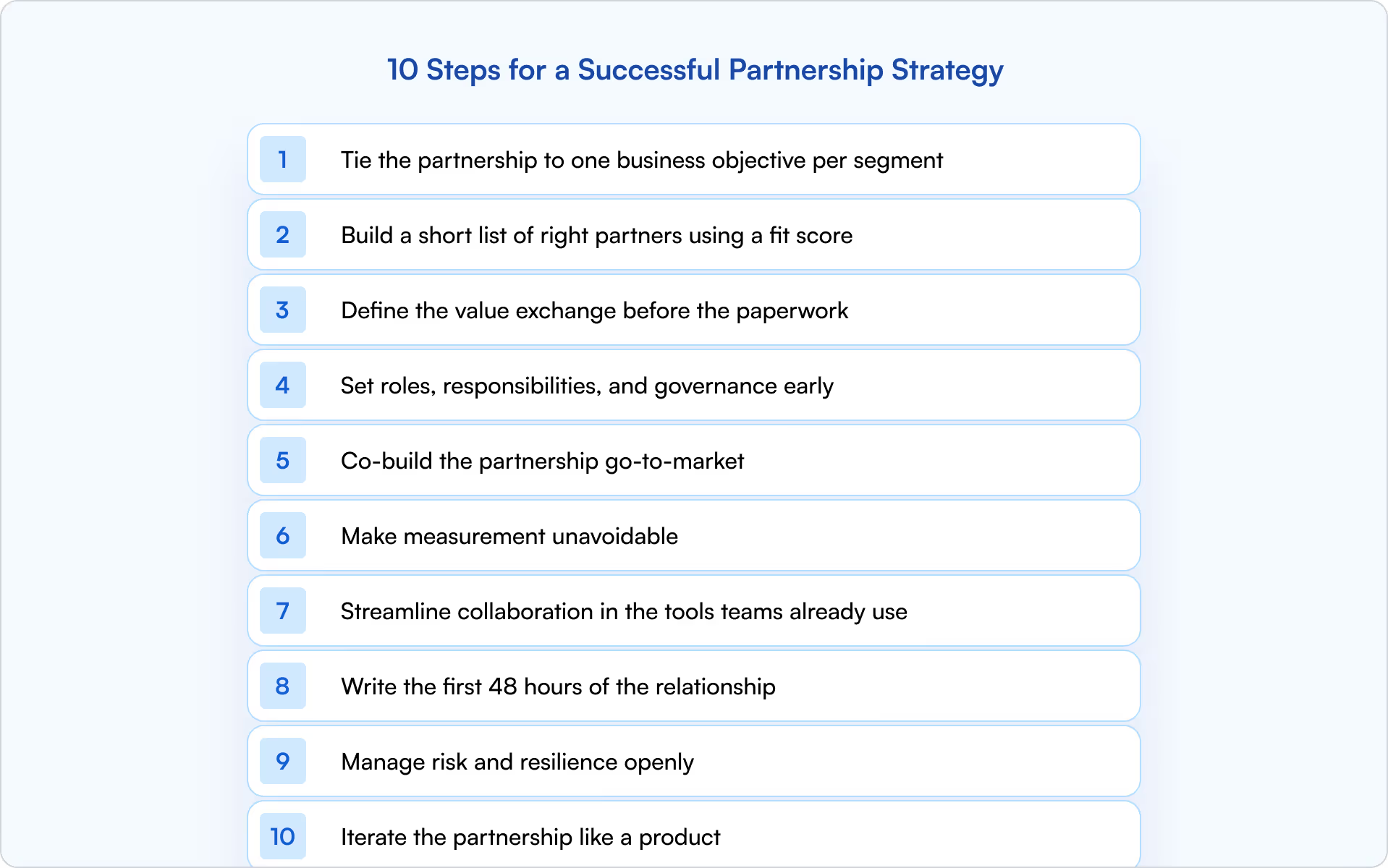
1) Tie the partnership to one business objective per segment
Start with a clear strategy: name the strategic objectives your partnership should serve — new markets, product acceleration, supply chain resilience, or pipeline growth. For each segment (technology, channel, services), choose one primary outcome and the few metrics that prove progress. This avoids vague “collaboration” and creates focus for stakeholders involved. Document partnership objectives, decision owners, and review cadence so everyone understands why this strategic partnership exists and how it advances the organization’s success.
2) Build a short list of right partners using a fit score
Evaluate potential partners against a simple scorecard: strategic alignment to business needs, complementary capabilities, access to respective customers, brand strength, and operating readiness. Include cultural markers like responsiveness and executive sponsorship. Look beyond obvious names; prospective partners in adjacent categories (for example, a data vendor plus a cloud solutions integrator) can unlock competitive advantage through complementary skills. Keep a “no for now” list so business development doesn’t restart from zero next quarter.
3) Define the value exchange before the paperwork
A successful partnership begins with a clear value exchange: what each partner brings (product, market reach, content, sales tools), what each expects (pipeline, co-marketing, integration work), and what each commits to in the first 90 days. Draft the value map first; then translate it into a strategic partnership agreement. This avoids legal-heavy starts with light substance. Outline joint offers, routes to market, pricing, and how you’ll handle shared leads to prevent downstream friction.
4) Set roles, responsibilities, and governance early
Great relationships fail without clear ownership. Name an executive sponsor, a partner manager on both sides, and a cross-functional squad (sales, marketing, product, legal, finance) accountable for day-to-day execution. Create a lightweight governance rhythm: monthly operating review, quarterly strategy checkpoint, and a shared risk log. Agree on escalation paths and response-time expectations so issues don’t linger. When two companies move quickly, clarity beats charisma.
5) Co-build the partnership go-to-market
Partnership development moves faster when there’s a real offer and plan. Package a joint solution with messaging, target accounts, and sales strategies that show how the combined value solves a specific problem. Align joint marketing efforts: a webinar, a customer story, and a field enablement session. Decide who funds what, who owns lists, and how leads are routed. Keep timelines short so momentum turns into pipeline within the first 60–90 days.
6) Make measurement unavoidable
Agree on a small set of key performance indicators: sourced pipeline, influenced revenue, cycle time, win rate, integration adoption, and net revenue retention for joint customers. Track them weekly in your CRM; review monthly together. Add leading indicators such as partner-sourced meetings and asset usage so you can adjust early. Tie incentives to these numbers so teams have shared reasons to act. Boring reporting leads to exciting outcomes.
7) Streamline collaboration in the tools teams already use
Partnerships stall when they require new logins or side spreadsheets. Operate in the systems your sellers and partner teams already use. Keep the partner ecosystem visible in the CRM, use email and Slack to move deals forward, and sync those messages back to the opportunity so history isn’t trapped in inboxes. This is where Introw helps: no-login registration, reply-to-update collaboration, and clean sync to Salesforce or HubSpot keep everyone on the same page without extra effort.
8) Write the first 48 hours of the relationship
Partnership strategy development often forgets day zero. Script the onboarding: kickoff agenda, shared drive links, point-of-contact list, access to training materials, and the first three co-selling actions. Provide sales tools (one-pagers, decks, discovery guides), a short integration brief, and a sample outreach sequence. The faster both teams can run a real motion, the sooner the relationship proves value to senior leadership.
9) Manage risk and resilience openly
Strong partnerships acknowledge potential risks up front: overlapping products, long certification cycles, data-sharing rules, or supply chain constraints. Capture these in a shared risk register with owners and dates. If corporate sustainability priorities or compliance requirements affect the partnership, spell them out early. Clarity on constraints builds trust and prevents surprises that derail otherwise successful strategic partnerships.
10) Iterate the partnership like a product
Market dynamics shift. Treat the partnership like a living product: quarterly backlog, small experiments, and clear retire/expand decisions. Add new technologies or joint features when the data supports it; retire motions that don’t convert. Invite customer success to share post-sale insights so you’re not only winning deals but delivering value to the customer base. Adaptive management turns a good start into long term success.
A Simple Partnership Strategy Framework You Can Reuse
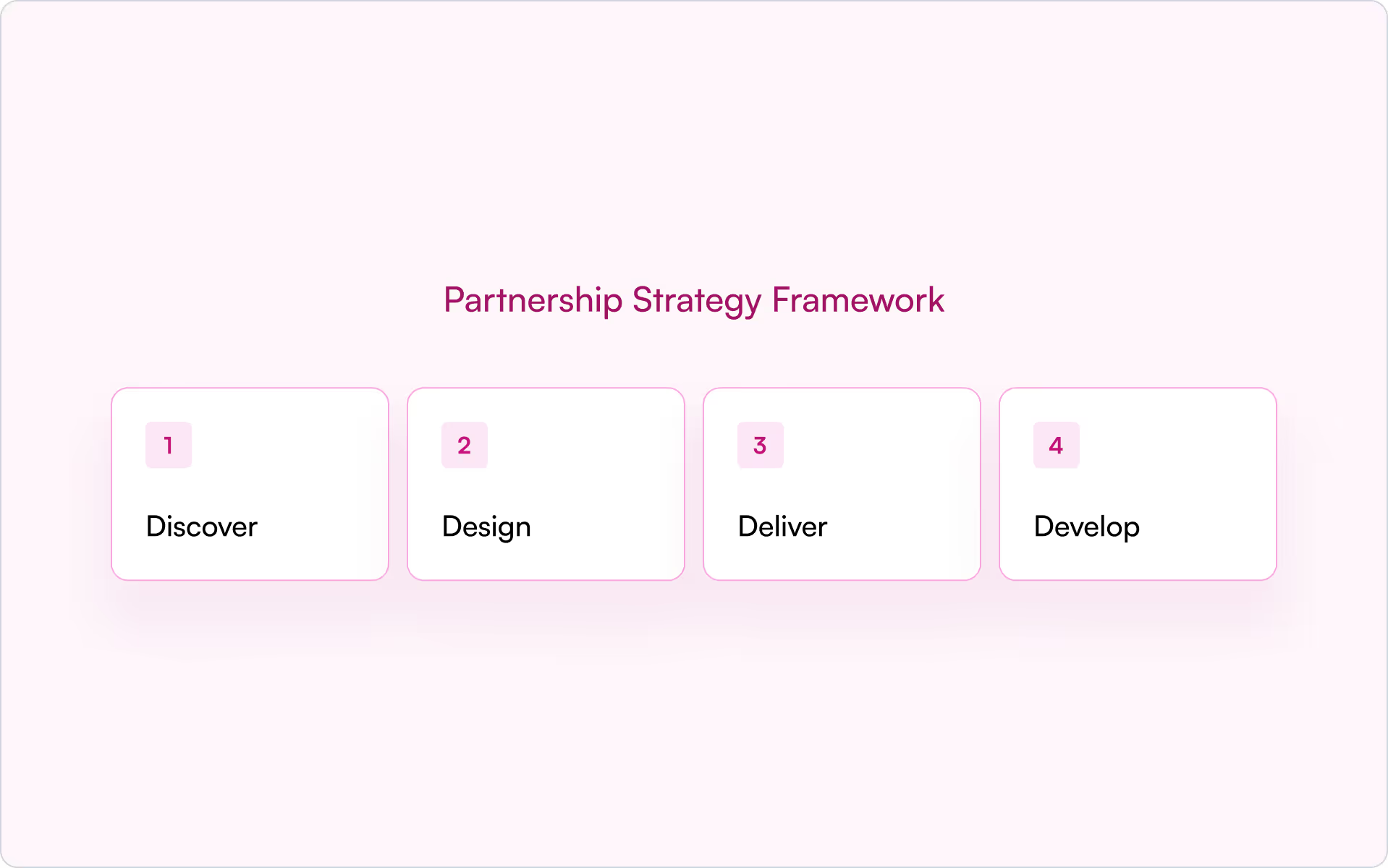
- Discover: map partnership opportunities, evaluate potential partners, and confirm strategic alignment.
- Design: define value exchange, roles and responsibilities, and operating rhythm; draft the partnership agreement.
- Deliver: launch a joint motion with campaigns, enablement, and pipeline targets; measure with shared KPIs.
- Develop: expand what works, fix what lags, and evolve the scope with innovative ideas and market insights.
How Introw Supports Partnership-Driven Success
Introw operationalizes partnership management strategies by keeping collaboration CRM-first. Teams register and track partner progress inside Salesforce or HubSpot, automate updates by email or Slack, and keep joint action plans visible on opportunities and accounts. For partner managers, this reduces swivel-chair work and keeps stakeholders aligned. For RevOps, it maintains clean data and trustworthy reporting. For CROs, it links partnership activities to forecast accuracy and revenue growth — the metrics that matter when you scale building partnerships across categories and regions.
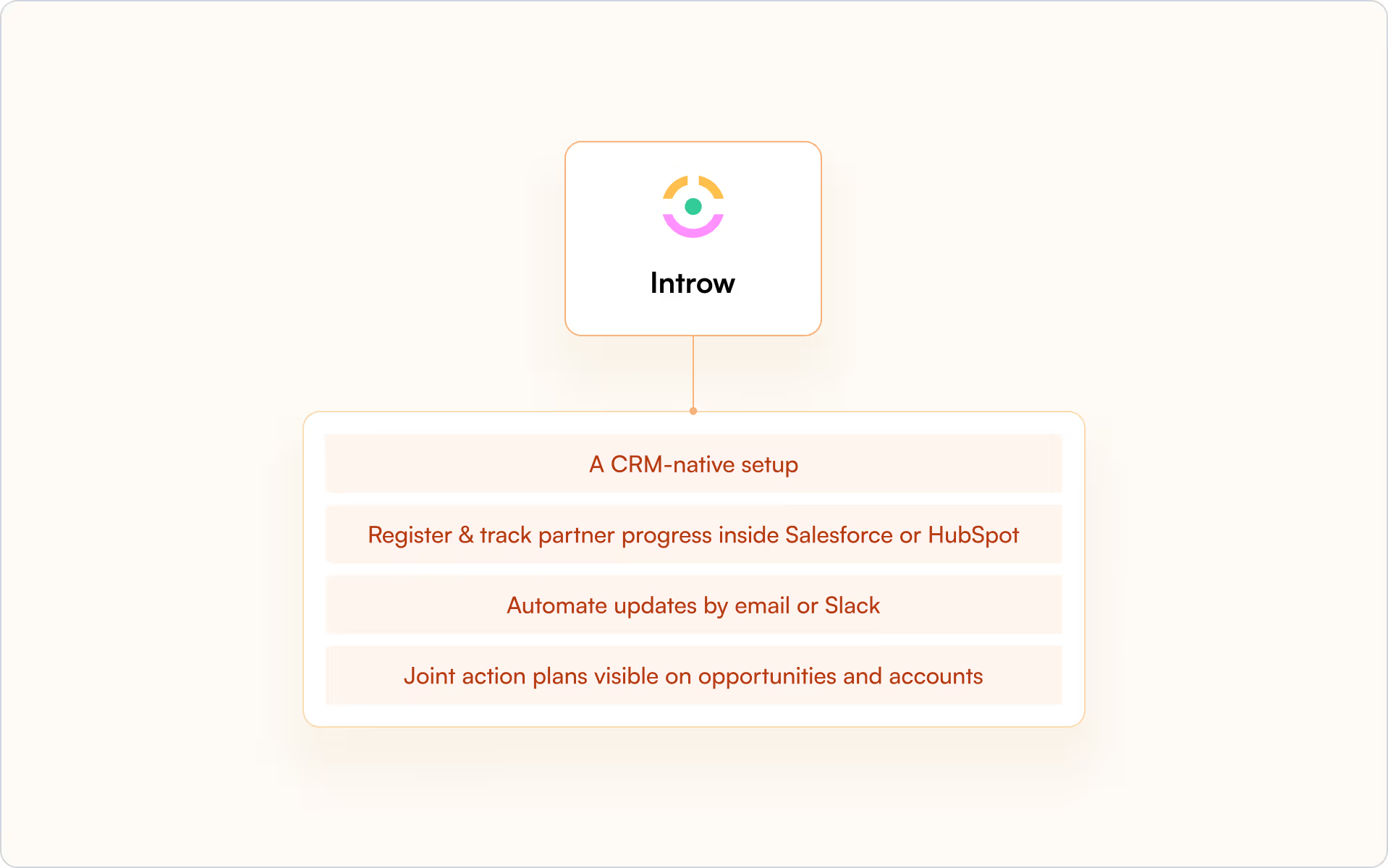
Conclusion
A successful partnership strategy blends clarity and cadence: clear objectives, a disciplined evaluation of the right partners, a concrete plan to reach new markets, and an operating model that runs in the tools your teams already trust. When you do that — and measure what matters — strategic partnerships stop being slogans and start becoming a growth engine. If you want the mechanics to feel easier, consider a CRM-first platform like Introw to streamline collaboration, surface KPIs, and help two companies move as one team.
Best 17 Everflow Alternatives to Optimize Your Partner Program in 2026
Why Consider an Everflow Alternative in 2026?
When scaling a SaaS partner program, choosing the right technology stack is critical — but not all “partner platforms” are created equal. Everflow is a popular platform in the affiliate marketing world, built for B2C brands and digital commerce teams that want to manage high-volume, transactional affiliate or influencer relationships. But for SaaS companies running B2B partner programs — especially those focused on co-selling, enablement, and revenue collaboration — affiliate tools like Everflow simply aren’t designed for the job.
Everflow’s core strengths are affiliate link creation, payout automation, and large-scale tracking — ideal for e-commerce or consumer referral programs. If your goal is to manage influencer marketing, run pay-per-click campaigns, or turn your customer base into referral partners, Everflow is a solid choice.
However, Everflow is not built for B2B SaaS channel programs where:
- You need to train or enable partners with content and resources
- You want to co-sell and collaborate on pipeline, not just pay out commissions
- You work with resellers, referral partners, or managed service providers
- Your revenue team relies on real-time CRM data for forecasting and attribution
In short: Everflow is a strong B2C affiliate tool, but not a PRM (Partner Relationship Management) solution for SaaS. If you’re building a modern B2B partner ecosystem, you’ll want a CRM-native PRM platform that supports deep engagement, automation, and revenue alignment across your entire partner lifecycle.
What to Look for in an Everflow Alternative — If You’re Considering a True PRM
If you’re evaluating alternatives to Everflow because you want to do more than just affiliate payouts — like building lasting partner relationships, driving co-selling, or enabling resellers — you’re really in the market for a Partner Relationship Management (PRM) solution, not another affiliate tool.
Here’s what to prioritize if you’re ready for a real PRM:
- CRM-Native Workflows: Seamless integration with Salesforce or HubSpot to keep partner data and deals in your single source of truth
- Automation: Onboarding, deal registration, communications, and reporting handled automatically — not through manual tracking
- Off-Portal Engagement: Communicate and collaborate with partners via Slack, email, or other tools they already use (no portal logins required)
- Real-Time Analytics: Pipeline, attribution, and forecasting updated live inside your CRM
- Scalability: Manage anywhere from 10 to 300+ partners, each with customized journeys and permissions
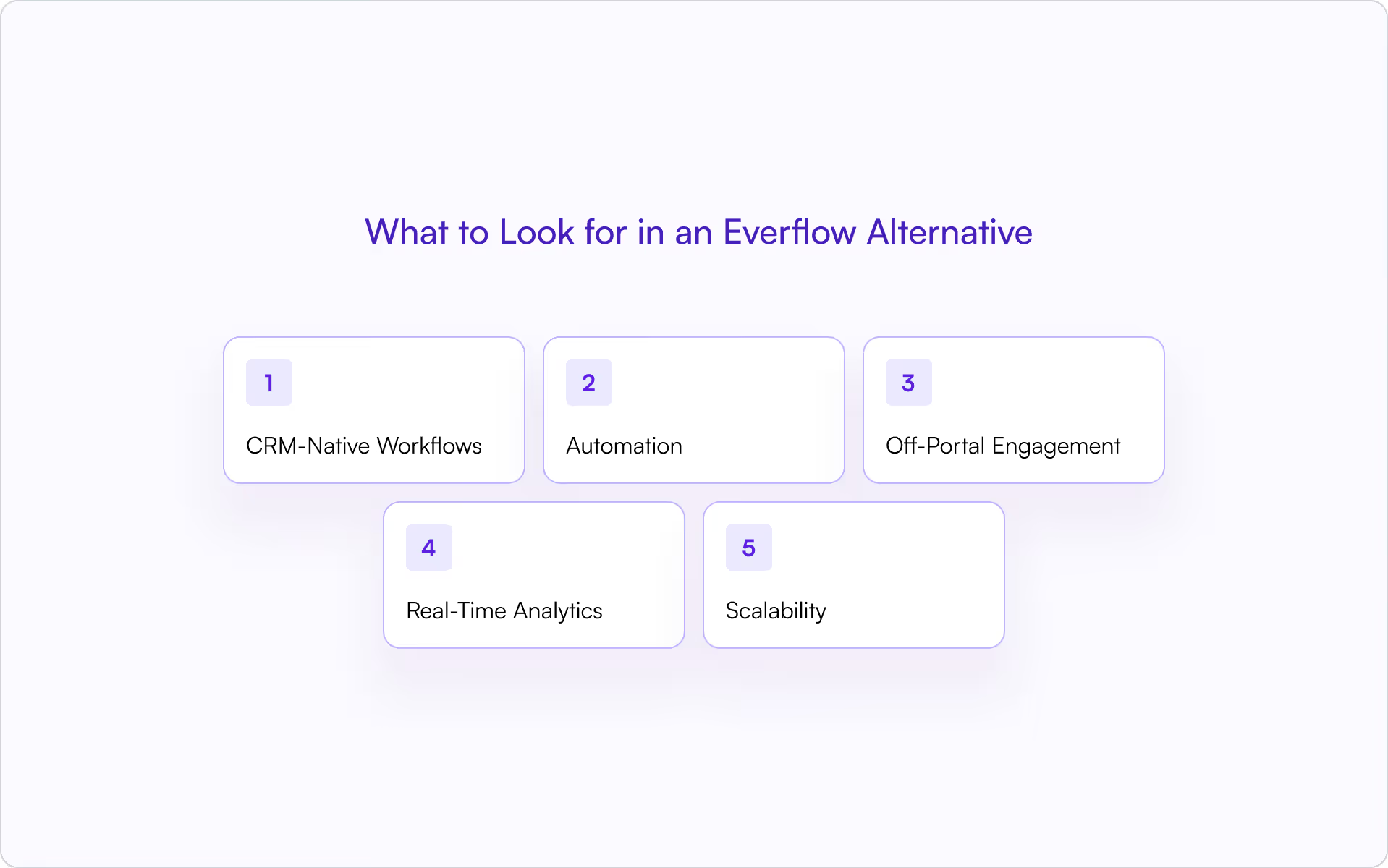
The bottom line: If you’re running a B2B SaaS partner program and want more than basic affiliate marketing, focus on platforms designed for lasting, revenue-driven relationships — not just transactional tracking.
17 Best Everflow Alternatives for SaaS & B2B Partner Programs (2026)
There are plenty of great Everflow alternatives out there in 2026.
Here are our 17 top picks of the best Everflow alternatives, alongside their stand-out use cases and pros and cons.
1. Introw
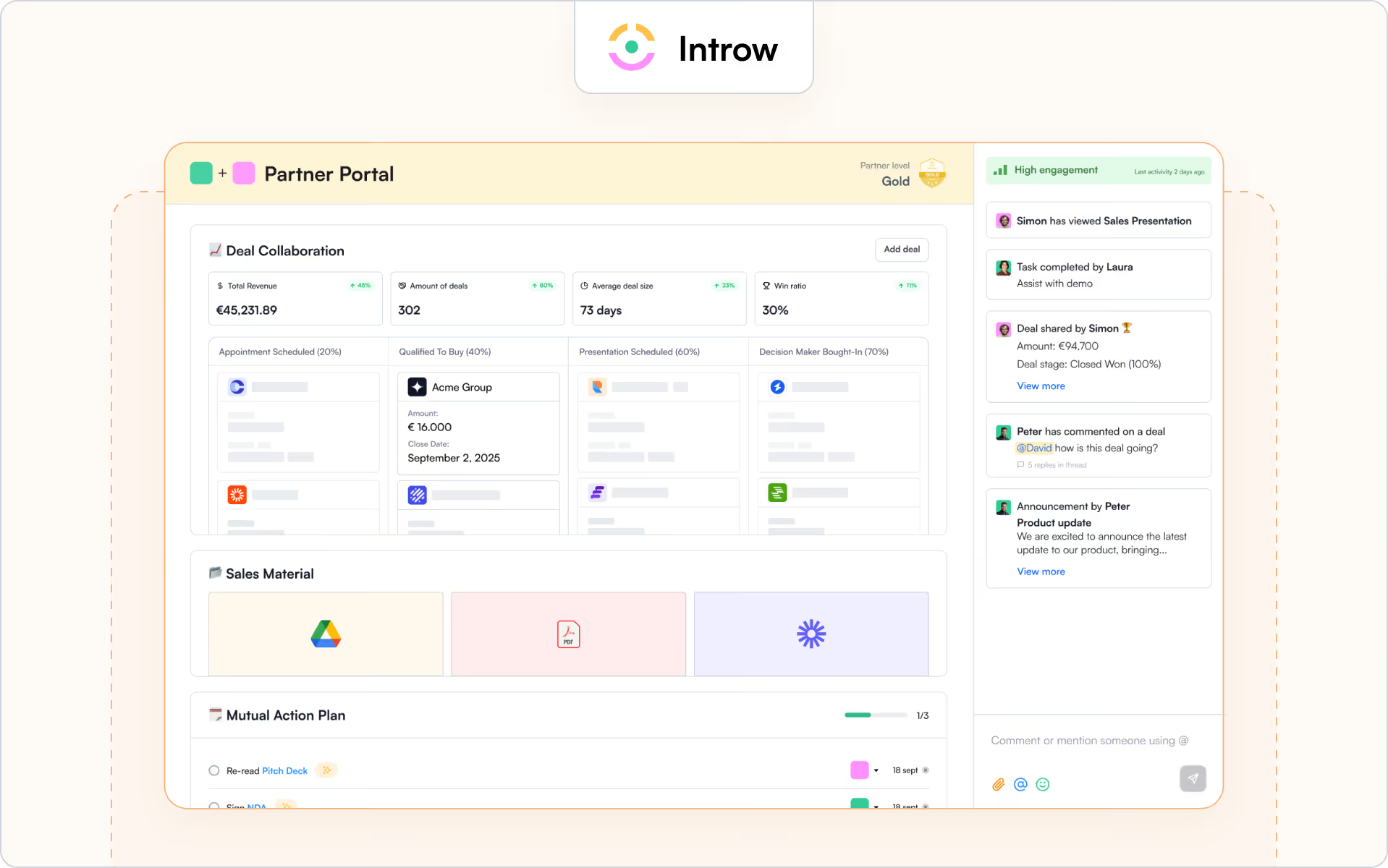
A modern, CRM-first PRM platform that integrates deeply with Salesforce and HubSpot. Introw empowers businesses to launch branded partner portals in minutes — no coding needed.
Other highlights include:
- Off-portal comms
- Deep engagement tracking
- Automated deal registrations and partner updates, with no login required
- Customizable by partner type or tier
It also automates deal and lead registration, commissions, and real-time partner engagement via email or Slack; all synced seamlessly with CRM data.
Best for: SaaS teams needing CRM-first partner automation
Why switch? Introw empowers SaaS teams to go beyond affiliate marketing and run true co-selling and revenue-generating programs.
Request an Introw demo here today.
2. PartnerStack

PartnerStack is a full-stack PRM and partner ecosystem platform for B2B SaaS companies.
It's an effective platform for rapid partner scaling but less so when it comes to deep channel sales.
Key features include:
- Scalable portal
- Easy payouts
- Partner marketplace
Best for: SaaS looking to blend affiliate, referral, and reseller
Pros and cons: While PartnerStack offers a solid onboarding facility, its CRM integration is limited.
3. Kiflo
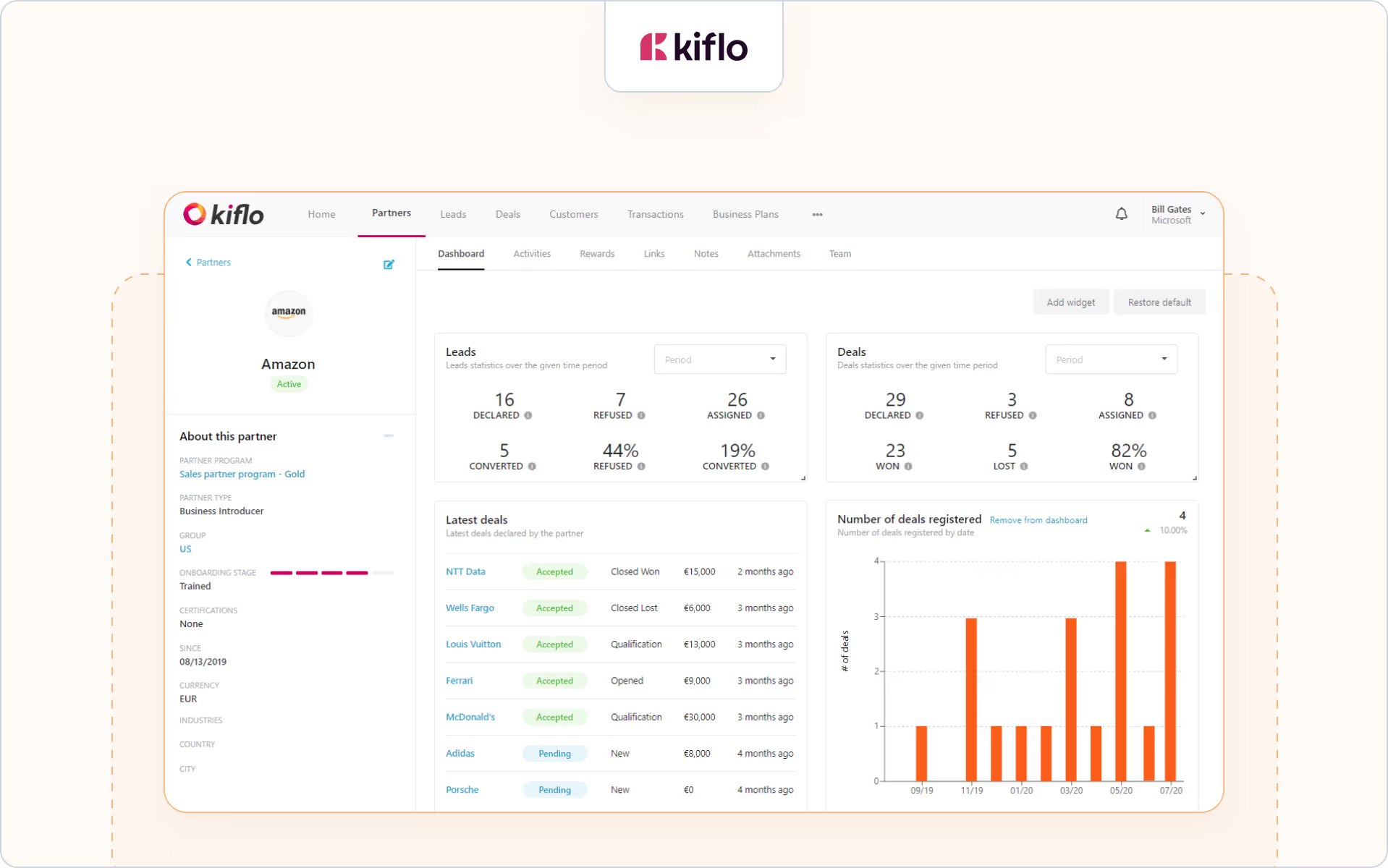
Kiflo is a PRM platform designed to streamline the entire partner lifecycle for SMBs.
It offers simple and affordable partner management but is not designed for highly complex workflows.
Highlights include:
- Clean UI
- Lead and deal registration
- Partner onboarding templates
Best for: SMBs or new SaaS partner programs
Pros and cons: Good for co-marketing, but lighter on integrations and automation
4. Channelscaler

Channelscaler is a unified PRM and channel program automation platform born from the merger of Allbound and Channel Mechanics.
The platform is portal-based with some CRM integration via API.
Key features include:
- Deal registration
- Co-selling
- Enablement/content
- QBR tools
Best for: Enablement-heavy SaaS partner orgs
Pros and cons: Channelscaler is an excellent option for enablement but can be overkill for small teams
5. Impact.com
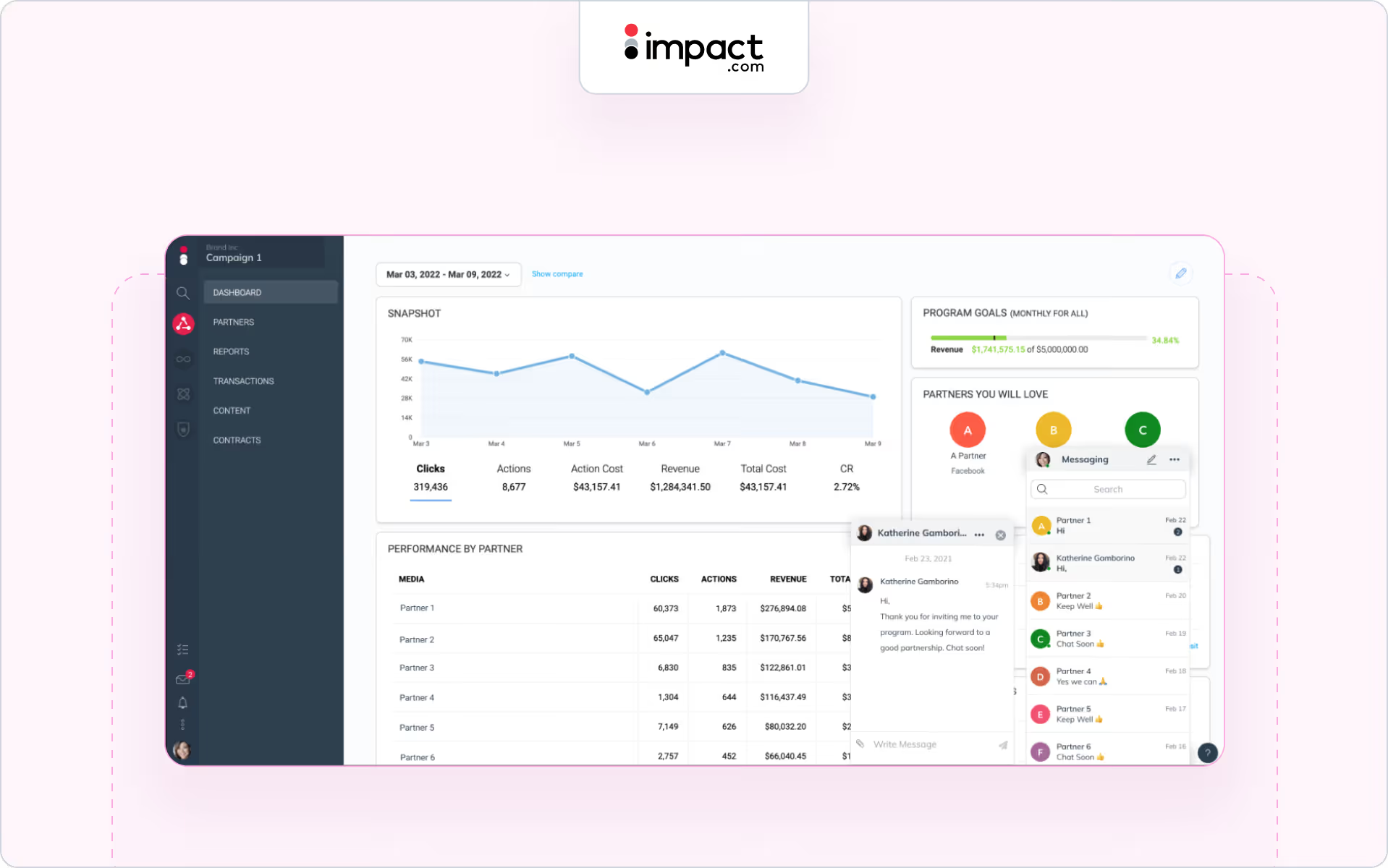
Impact.com is an all‑in‑one partnership management platform that empowers brands to manage diverse partner types — affiliates, influencers, creators, and referral advocates — within a unified interface.
It automates the full partner lifecycle, from recruitment and contracting to tracking, payouts, and performance optimization.
However, it's worth noting that Impact.com offers fewer B2B and channel features than many other platforms, and its CRM integration is limited, too.
Top features include:
- Marketplace
- Deep affiliate tracking
- Payout automation
Best for: Affiliate-first organizations, influencer, and content partnerships
Pros and cons: Impact.com is best suited for scaling digital commerce and affiliate programs rather than SaaS channel co-selling.
6. Impartner
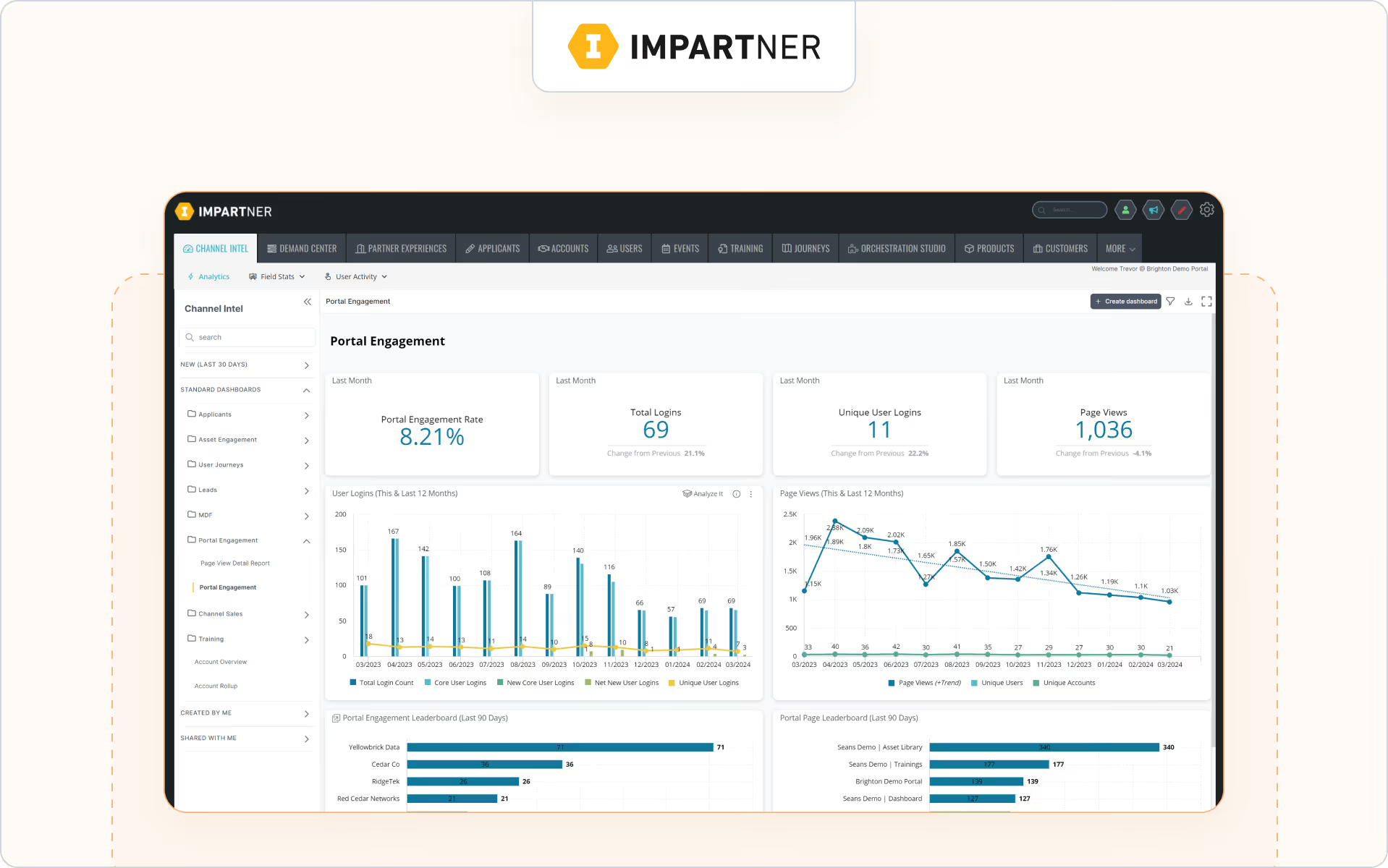
Impartner is a leading partner ecosystem platform that offers end-to-end PRM and Through-Channel Marketing Automation (TCMA).
It simplifies the partner lifecycle — from recruiting and onboarding to training, marketing, deal registration, and performance analytics.
Highlights include:
- Full-featured PRM (including deal reg, MDF, onboarding, and analytics)
- Advanced role permissions
- Strong reporting
Best for: Enterprises, global channel programs
Pros and cons: A great option for large organizations with IT resources, but it has a slower setup than similar tools
7. Tune

TUNE (formerly HasOffers) is a flexible SaaS platform designed for brands, agencies, and networks, offering a comprehensive solution for partner marketing.
It's important to bear in mind that this is a digital-first platform and is not ideal for SaaS channel sales.
Key features include:
- Flexible tracking
- API
- Good mobile support
Best for: Affiliate/performance marketing (mobile, app, gaming)
Pros and cons: TUNE offers API integration, fraud prevention, and real-time reporting but lacks partner co-selling and CRM integration.
8. Partnerize
Partnerize is an AI-powered partnership automation platform that helps enterprises manage, optimize, and vault affiliate, influencer, and referral programs end‑to‑end.
The platform's highlights include:
- Affiliate, influencer, B2B, and channel all in one platform
- AI-powered optimization
- Flexible reporting
Best for: Large brands managing mixed partner ecosystems
Pros and cons: Partnerize works best for companies with big budgets and delivers big reach — but it's not tailored for SaaS workflows.
9. Zift Solutions

Zift Solutions — a unified PRM and through-channel marketing automation platform for indirect selling — promises to optimize campaigns and deliver happier partners.
It excels in channel marketing and automation for large teams.
Platform highlights include:
- MDF
- Campaign management
- Strong integrations
Best for: Channel marketing automation at enterprise scale
Pros and cons: Zift Solutions offers robust reporting but can be complex
10. Crossbeam
Crossbeam is an ecosystem‑led growth platform that securely connects partner CRMs and data sources to identify account overlaps, surface warm leads, and enable co‑selling.
This platform is designed to help sales teams uncover partnership opportunities and drive ecosystem‑based revenue — and should be used to supplement your CRM and/or PRM.
Crossbeam's key features are:
- Account mapping
- Partner overlap
- Joint pipeline tracking
Best for: SaaS with ecosystem and co-selling focus
Pros and Cons: Crossbeam is not a full PRM, but it's super useful for ecosystem data
11. Channeltivity
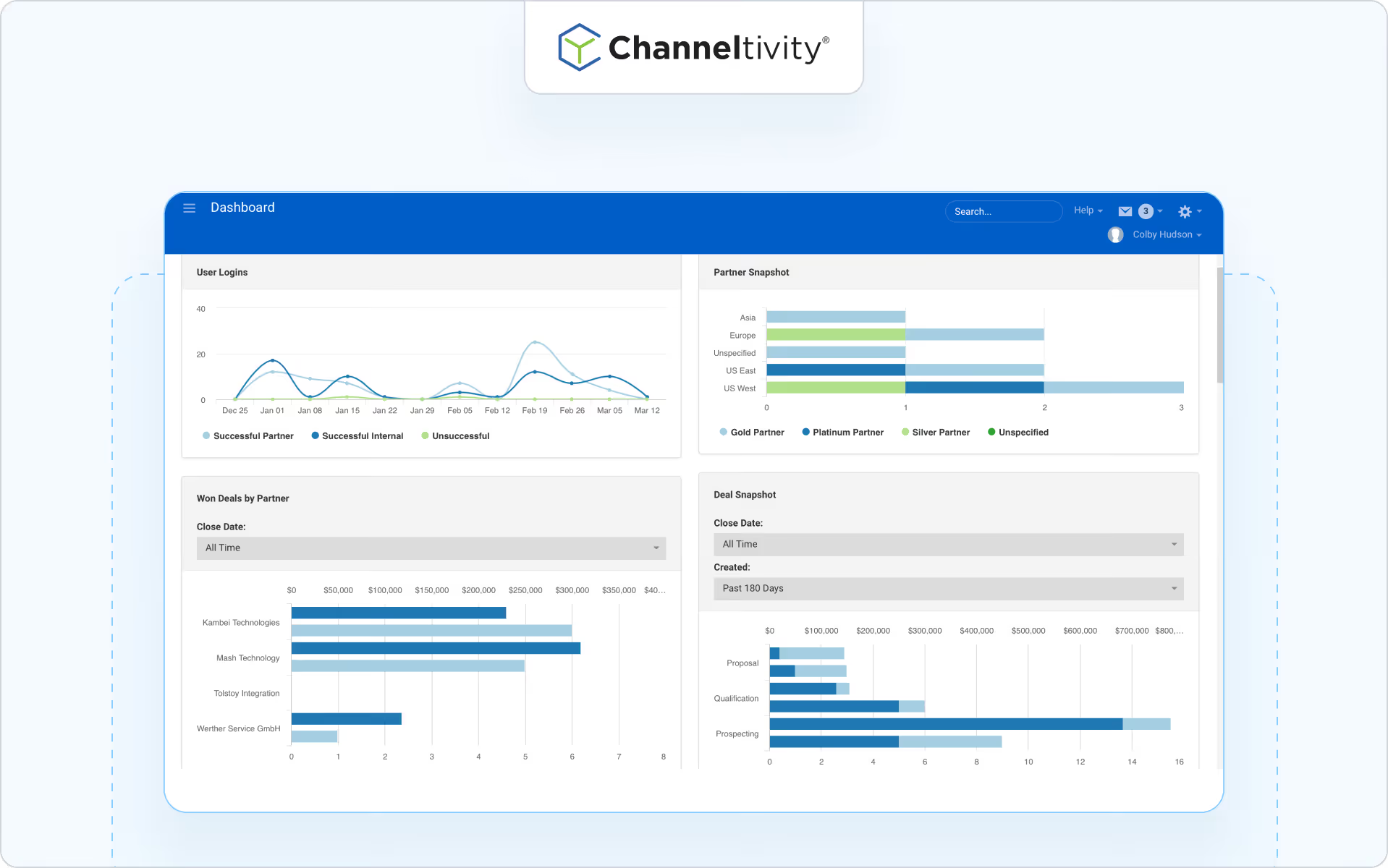
Channeltivity is a cloud-based PRM and channel management software designed to help companies build, scale, and optimize their indirect sales programs.
It works well for classic channel teams rather than affiliate-heavy programs.
Key features include:
- Deal reg
- MDF
- Reporting
- Customizable portal
Best for: Mid-market B2B SaaS
Pros and cons: Quick to deploy and has HubSpot/Salesforce connectors but is not ideal for affiliate-heavy programs
12. Magentrix
Magentrix is a robust PRM and partner portal platform.
This software helps organizations streamline partner onboarding, deal registration, pipeline tracking, incentives, and training via a built-in learning management system.
Its LMS makes it an excellent fit for SaaS teams with heavy partner enablement or content needs.
Key features:
- PRM
- Community features
- Strong Salesforce integration
- Resource library
- Support tools
Best for: Teams needing robust partner portal customization
Pros and cons: Magentrix is highly flexible and scalable, but it does come with a learning curve, and its high level of customization means implementation can be slow.
13. Affise

Promising to help companies master performance marketing and mobile attribution, cloud‑based Affise simplifies partnerships — affiliate, influencer, app, and referral marketing.
This is a handy tool for teams that are digital-first, mobile-first, or work in e-commerce.
Highlights include:
- Flexible tracking
- Payout automation
- Supports mobile attribution data
Best for: Performance marketing and affiliate networks
Pros and cons: Affise is helpful in the B2C space, but it's not built explicitly for co-sell or B2B SaaS channels.
14. Salesforce PRM
Salesforce PRM is an extension of the Salesforce Sales Cloud that empowers companies to manage channel sales with their partners.
As you'd imagine, it's fully integrated with Salesforce CRM, enabling organizations to grow indirect sales and collaborate efficiently with their partner ecosystem.
Salesforce PRM is a top choice for teams with SFDC admins or those who need single-source-of-truth
Key features include:
- Native integration
- Customizable objects
- Customizable workflows
Best for: Organizations already on Salesforce
Pros and cons: Salesforce PRM offers built-in reporting but has limited out-of-the-box PRM features
15. Elioplus
Elioplus is a B2B platform for software and cloud vendors that simplifies channel growth by combining partner recruitment with PRM features.
It's best used for building partner networks rather than scaling complex programs.
Highlights include:
- Marketplace
- Partner discovery
- Some PRM features
Best for: SaaS/IT vendors looking for partner recruitment
Pros and cons: The software's emphasis on partner recruitment is valuable for those building their partner program, but Elioplus is limited when it comes to automation and deep integrations.
16. Post Affiliate Pro
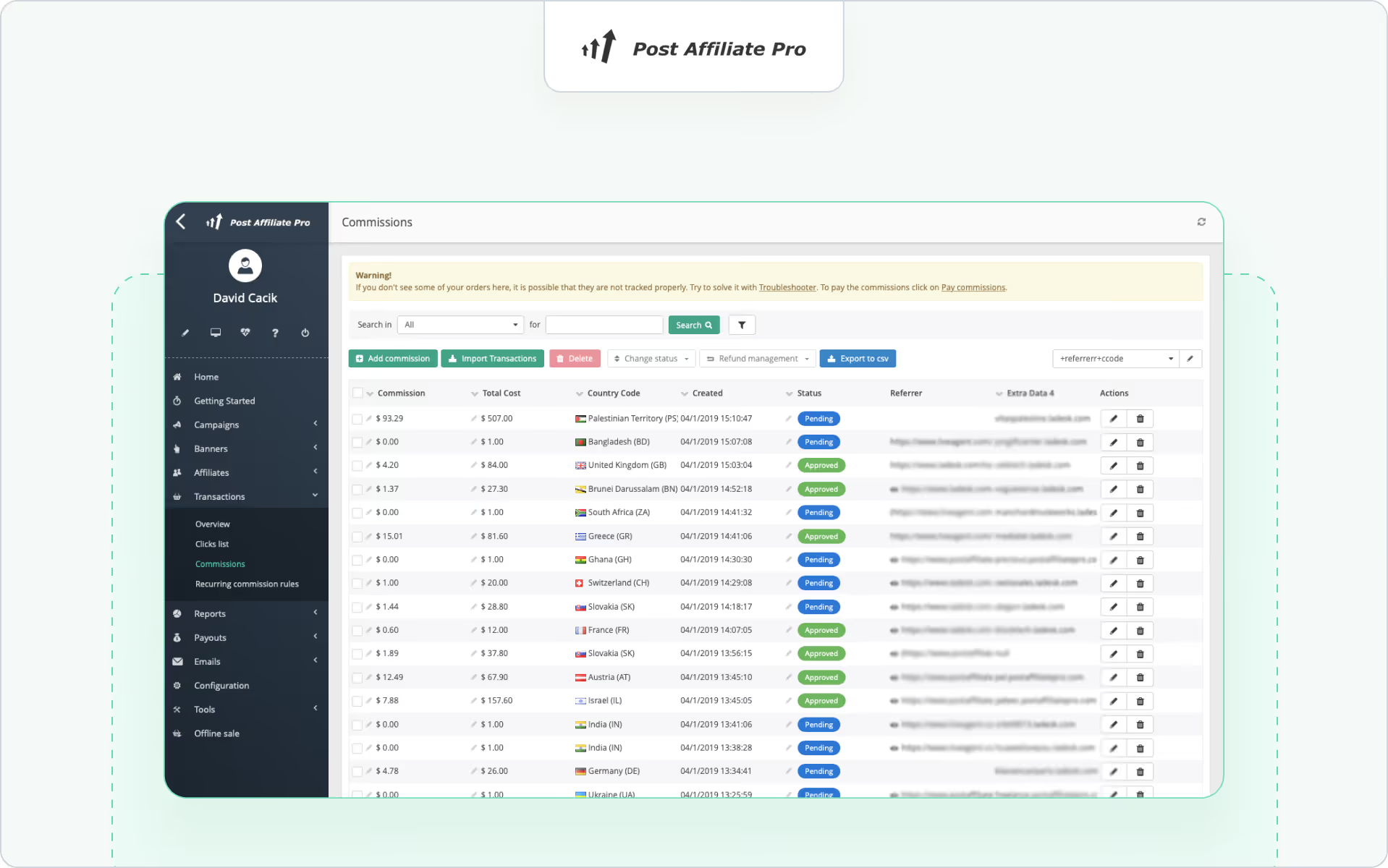
Need a software that will help you launch, track, and manage affiliate programs at scale?
Take a look at Post Affiliate Pro, which is designed for affiliate programs.
If you're looking for channel sales support, however, this may not be the software for you.
Key features of Post Affiliate Pro include:
- Multi-currency
- Campaign management
- Automated commission payments
Best for: Affiliate marketing and pay-per-performance schemes
Pros and cons: While useful for affiliate programs, it's not focused on B2B or SaaS channels.
17. WorkSpan
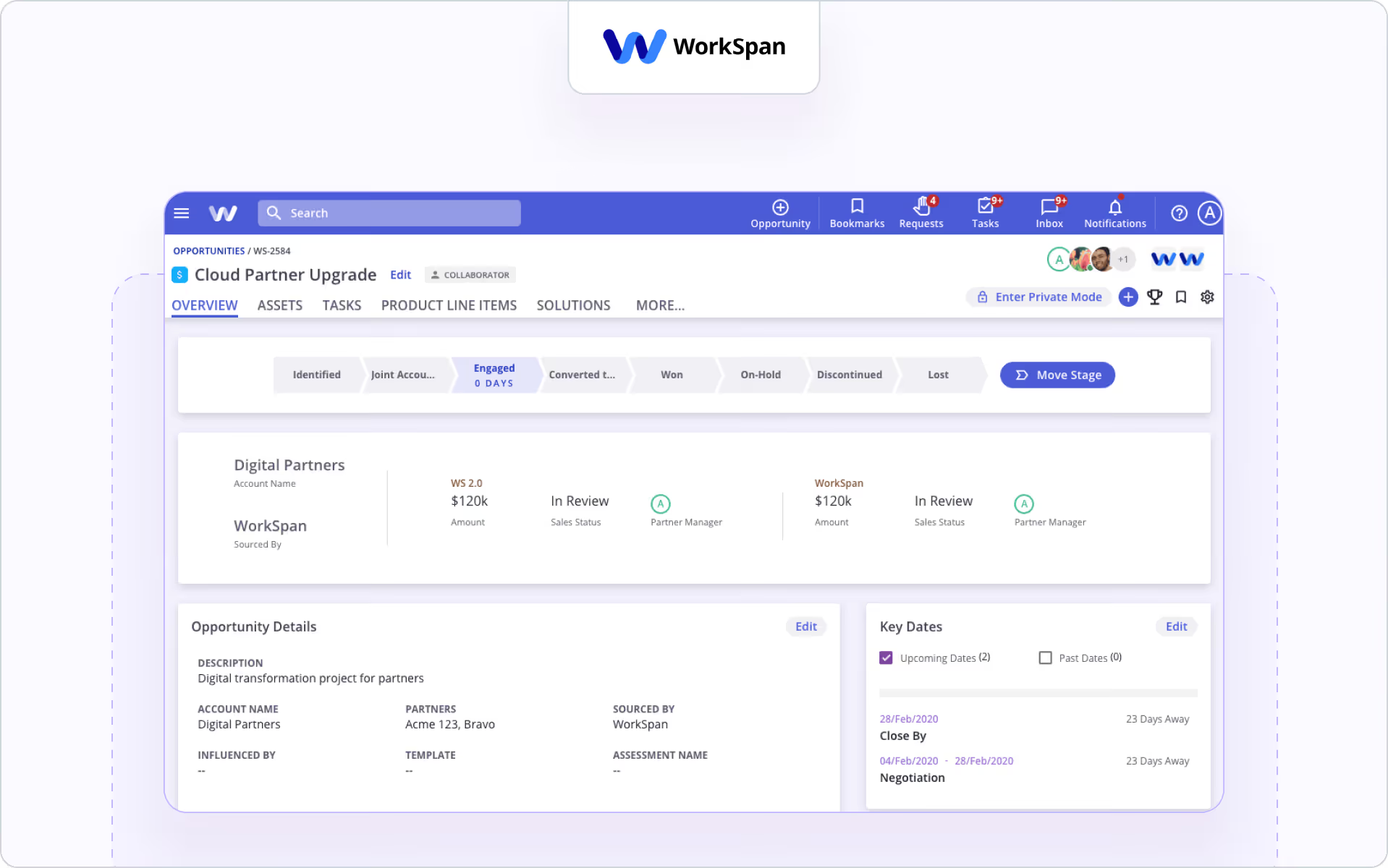
WorkSpan is a SaaS-based ecosystem business‑management platform that unifies co‑selling, co‑marketing, co‑investing, and co‑innovating across partner networks.
Features include:
- Joint pipeline tracking
- Workflow automation
- Real-time referral sharing
- Salesforce integration
- Comprehensive data visibility
Best for: Co-selling, alliance, and ecosystem management
Pros and cons: This software is a good fit for businesses with complex ecosystems but not classic affiliate programs.
Why SaaS Teams Upgrade to Introw
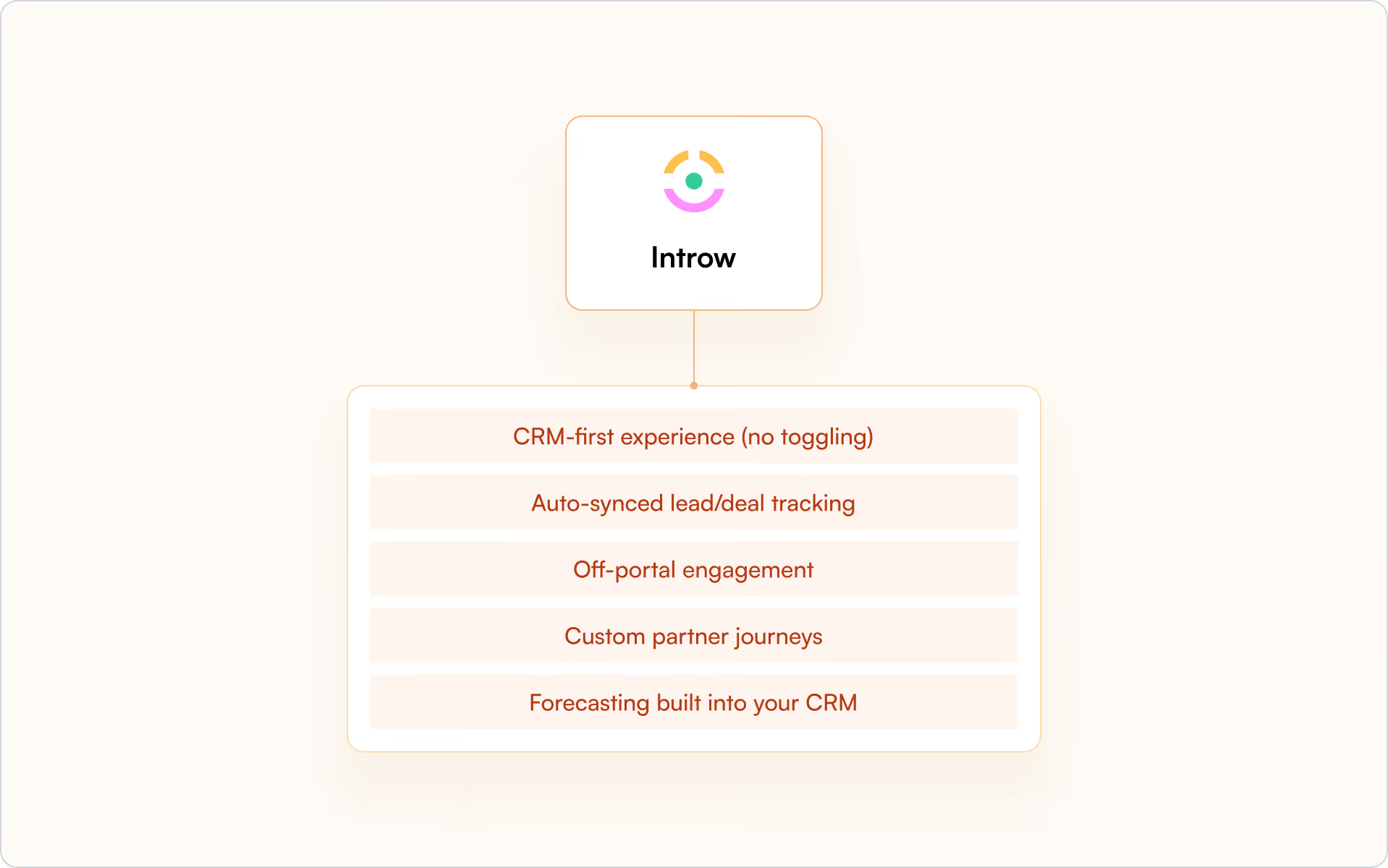
Modern SaaS teams need tools that match the speed and complexity of today's partner ecosystems while also simplifying collaboration and streamlining user journeys.
Here's why leading SaaS teams are making the switch to Introw.
CRM-native workflows
Introw works directly within your existing CRM, so your team gets to keep using familiar tools without any disruption, and you get to retain your single source of truth.
👉 Find out more about Introw's HubSpot and Salesforce integrations.
Off-portal engagement
Forget forcing partners to log into separate portals — this is a fast track to disengagement.
Introw enables seamless communication and collaboration outside of portals (such as email and Slack), reducing friction and keeping partners engaged where they already work.
Instant analytics
Action real-time insights with analytics that update instantly.
Track partner performance, spot trends early, and make data-driven decisions without waiting for reports.
No more missed updates or chasing partners
Stay effortlessly connected with automated alerts and notifications.
Role-based dashboards for managers, RevOps, and CROs
Everyone on your team gets personalized dashboards tailored to their needs.
This means managers, RevOps, and CROs can easily access the data that matters most to them, empowering them to make faster and smarter decisions.
Introw has been proven to scale SaaS partner revenue — request a demo here today.
Conclusion
Today's partner programs demand more than just tracking — they require deep CRM integration, automation to reduce manual work, and meaningful engagement that create results.
It's fair to say that traditional tools and disconnected portals simply can't keep up with the speed and complexity of modern SaaS ecosystems.
What are the next steps for organizations building and running modern partner programs?
- Evaluate the leading partner management solutions
- Schedule a live demo with your team
- Choose a platform that can future-proof your channel strategy as you grow
After all, the right tool can make all the difference in unlocking partner-led revenue.

